

Industrial Ozone and Oxygen Mixing Pump
1. Product Overview
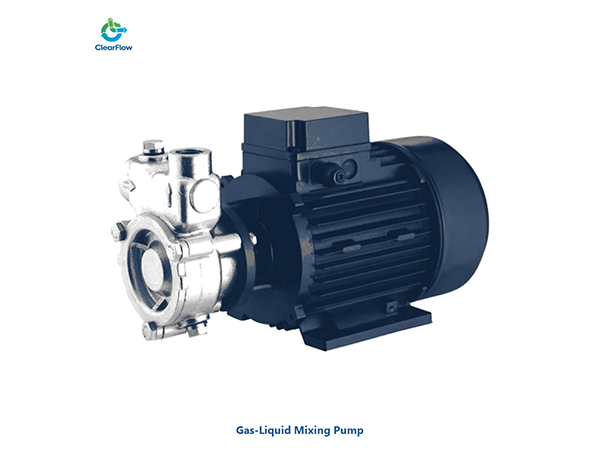
ClearFlow Gas-Liquid Mixing Pumps are designed for efficient gas and liquid mixing, gas dispersion, and gas dissolution in industrial water treatment systems. They can draw air, oxygen, or ozone into the pump through the suction side and mix it with water through a multi-blade impeller.
During operation, the impeller generates strong shear and turbulent mixing forces, dispersing the incoming gas into fine bubbles and promoting gas-liquid contact under pressure. This integrated process allows the pump to perform gas intake, mixing, and pressurized delivery in one unit, without requiring a separate air compressor or gas injector for suitable applications.
Featuring a compact structure, self-priming gas intake, and stainless steel pump head, ClearFlow gas-liquid mixing pumps are suitable for ozone water mixing, oxygen dissolution, dissolved air flotation (DAF), aquaculture oxygenation, and wastewater treatment.
When combined with a gas dissolving tank, the pump can serve as a key component in compact ozone mixing, gas dissolution, and nanobubble generation systems.
2. Working Principle of Gas-Liquid Mixing Pumps
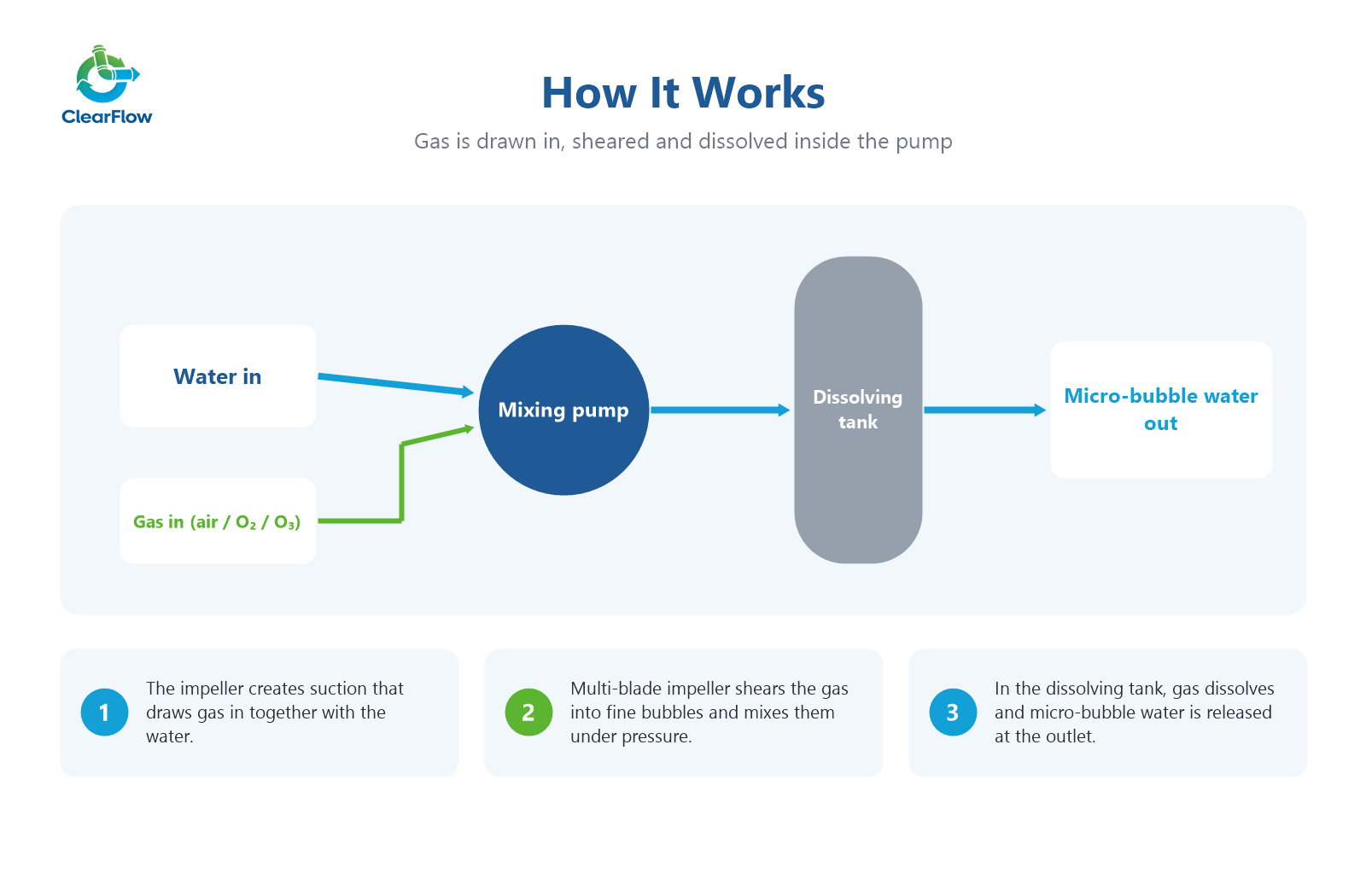
A gas-liquid mixing pump uses a high-speed rotating impeller to mix gas and liquid within the pump chamber.
The working process generally includes the following steps:
Step 1: Water Intake
Water enters the pump through the inlet and is transported into the mixing chamber by the impeller.
Step 2: Gas Self-Priming
Air, oxygen, or ozone is introduced through the gas suction port. The pump creates the required suction conditions to draw gas into the liquid flow without a separate compressor or injector under suitable operating conditions.
Step 3: Gas-Liquid Mixing
The multi-blade impeller generates high-speed shear forces and turbulent flow, breaking the incoming gas into smaller bubbles and distributing them throughout the water.
Step 4: Pressurized Delivery
The gas-water mixture is discharged under pressure. When connected to a dissolving tank, the system provides additional gas-liquid contact and pressure conditions to promote gas dissolution.
Step 5: Downstream Treatment
The mixed gas and water can be supplied to downstream treatment processes, including ozone oxidation, oxygenation, dissolved air flotation, and other water treatment applications.
The actual bubble size and gas dissolution efficiency depend on pump operating conditions, gas supply, water quality, system pressure, and the configuration of the downstream equipment.
3. Key Features and Advantages
3.1 Self-Priming Gas Intake
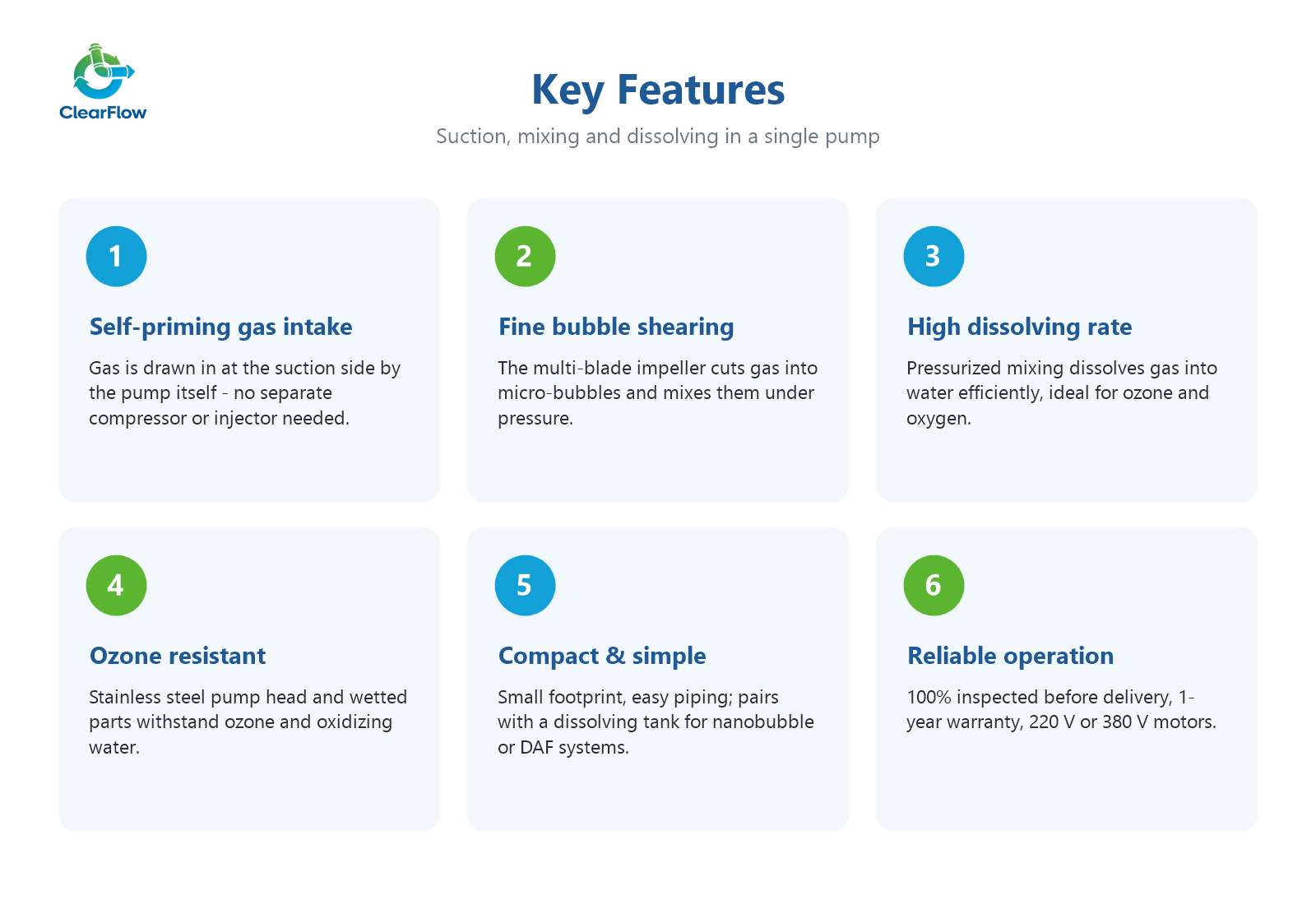
The pump can draw air, oxygen, or ozone directly into the mixing chamber through its gas suction port.
Key advantages include:
Integrated gas suction and liquid pumping.
No separate compressor or gas injector required for suitable configurations.
Simplified system structure.
Reduced auxiliary equipment requirements.
Convenient integration into water treatment systems.
3.2 Fine Bubble Generation and Gas-Liquid Mixing
The multi-blade impeller creates strong shear forces during operation, dispersing gas into fine bubbles and improving gas-liquid contact.
This mixing process helps promote gas dissolution and transfer in water.
Suitable for applications requiring efficient oxygen or ozone mixing.
3.3 Improved Ozone and Oxygen Dissolution
The gas-liquid mixing pump is particularly suitable for systems that require oxygen or ozone to be introduced into water.
When combined with a dissolving tank, the pump helps increase gas-liquid contact and supports improved dissolution efficiency.
Typical applications include:
Ozone water preparation.
Ozone oxidation systems.
Oxygen dissolution systems.
Aquaculture water treatment.
Industrial wastewater treatment.
3.4 Ozone-Resistant Pump Construction
For ozone-related applications, the pump is equipped with a stainless steel pump head and stainless steel wetted components.
This construction is designed to accommodate gas-liquid mixing processes involving ozone.
For long-term ozone service, the pump seal, gasket, impeller, and other wetted materials should also be confirmed for compatibility with the actual ozone concentration and operating conditions.
3.5 Compact Design and Easy Integration
The gas-liquid mixing pump integrates gas intake and liquid mixing into one unit, reducing the need for additional mixing equipment.
It can be combined with:
Gas dissolving tanks.
Ozone generators.
Oxygen supply systems.
Nanobubble generators.
Dissolved air flotation systems.
Its compact design makes it suitable for both new water treatment installations and upgrades to existing systems.
3.6 Quality Inspection and Warranty
Each ClearFlow gas-liquid mixing pump undergoes inspection before delivery to help ensure product quality and operating reliability.
100% inspection before delivery.
One-year warranty.
Customized motor configurations available.
220 V or 380 V power supply options.
60 Hz power supply available upon request.
4. Product Details and Main Components
Stainless Steel Pump Head
The pump head is manufactured from stainless steel to provide corrosion resistance for industrial water treatment applications.
It is suitable for air, oxygen, and ozone mixing applications, subject to the compatibility of all wetted components.
Multi-Blade Impeller
The multi-blade impeller is the core mixing component.
As it rotates at high speed, it generates shear and turbulence to disperse gas into fine bubbles and promote gas-liquid mixing.
Gas Suction Port
The gas suction port introduces air, oxygen, or ozone into the pump chamber.
The pump’s self-priming gas intake function simplifies the overall system configuration.
Motor and Drive System
The motor drives the impeller to provide the power required for liquid circulation and gas-liquid mixing.
Motor power and electrical configurations can be selected according to the pump model and project requirements.
Optional Gas Dissolving Tank
When connected to a gas dissolving tank, the pump can form a compact gas dissolution system.
The tank provides additional contact time and operating pressure conditions to support gas dissolution.
5. Technical Specifications
ClearFlow offers different gas-liquid mixing pump models to accommodate various water flow rates and system requirements.
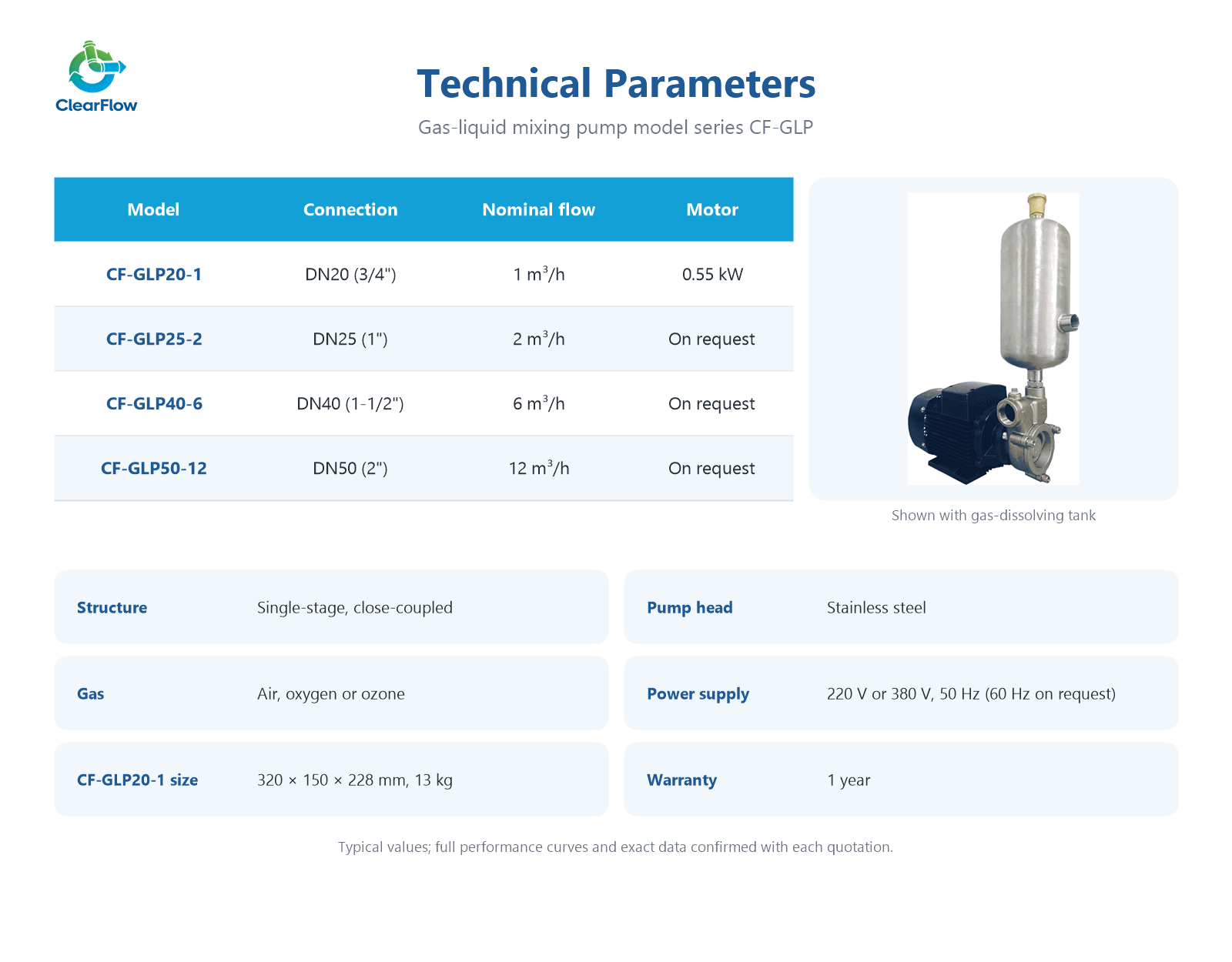
Note: Motor power, dimensions, weight, and other specifications for different models should be confirmed according to the final equipment configuration and quotation.
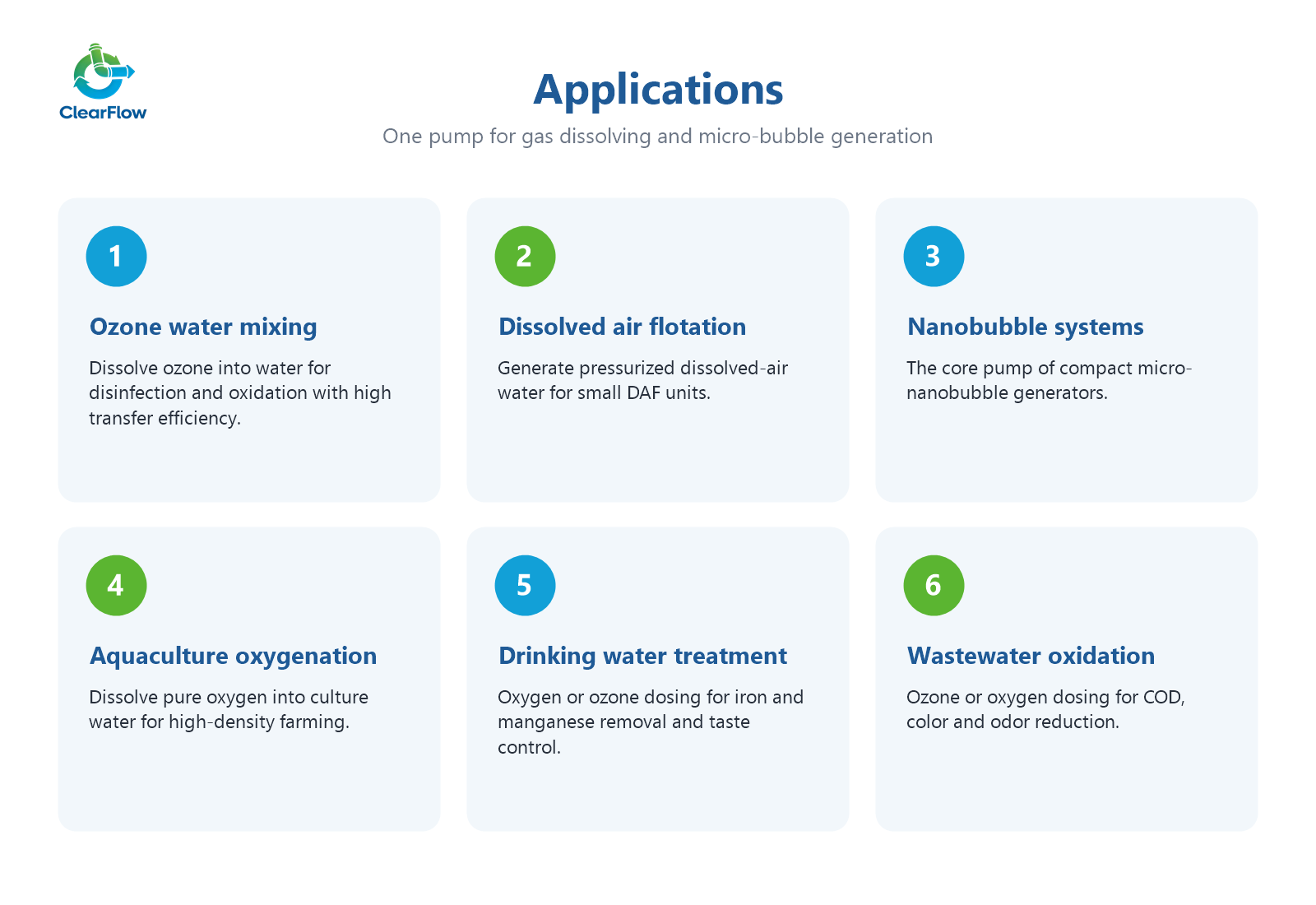
6. Applications of Gas-Liquid Mixing Pumps
ClearFlow gas-liquid mixing pumps are widely used in industrial water treatment systems that require efficient gas introduction, mixing, and dissolution.
6.1 Ozone Water Mixing Systems
The pump draws ozone gas into the water and mixes it through the impeller, helping improve ozone dispersion and gas-liquid contact.
Typical applications include:
Ozone water preparation.
Industrial wastewater oxidation.
Water disinfection systems.
Ozone treatment equipment.
Ozone generator integration systems.
6.2 Dissolved Air Flotation (DAF) Systems
Gas-liquid mixing pumps can be used in dissolved air flotation systems to mix air with water under pressure.
The pressurized water is subsequently released into the flotation tank, generating fine bubbles that attach to suspended particles and help them float to the water surface for separation.
Typical applications include:
Industrial wastewater pretreatment.
Food processing wastewater.
Oil-water separation.
Suspended solids removal.
Industrial water clarification.
6.3 Nanobubble Generation Systems
When integrated with suitable gas dissolution and pressure-release equipment, the gas-liquid mixing pump can serve as a key component in nanobubble generation systems.
It helps introduce and disperse gas into water, supporting downstream fine-bubble or nanobubble generation processes.
Applications include:
Ozone nanobubble water treatment.
Oxygen nanobubble systems.
Aquaculture water treatment.
Advanced oxidation processes.
The actual nanobubble size distribution and concentration depend on the complete system configuration and should be verified through testing.
6.4 Aquaculture Oxygenation
The pump can be used to introduce oxygen into water and improve gas-liquid mixing in aquaculture systems.
Typical applications include:
Fish farming.
Shrimp farming.
Recirculating aquaculture systems (RAS).
Aquaculture water circulation.
Oxygen dissolution systems.
6.5 Drinking Water Treatment
Gas-liquid mixing pumps can be integrated into drinking water treatment systems to introduce ozone for oxidation and disinfection processes.
They help improve the contact between ozone and water, supporting downstream treatment operations.
6.6 Industrial Wastewater Oxidation
The pump can introduce ozone or oxygen into wastewater treatment processes to promote gas-liquid mixing.
Potential applications include:
Wastewater oxidation.
Advanced wastewater treatment.
Industrial water purification.
Ozone-based decolorization systems.
Pretreatment and oxidation processes.
7. Integrated Gas-Liquid Mixing Solutions
ClearFlow gas-liquid mixing pumps can be integrated with other water treatment equipment to form complete gas mixing and dissolution systems.
Gas-Liquid Mixing Pump + Dissolving Tank
The pump mixes gas and water and delivers the mixture into a dissolving tank, where additional gas-liquid contact and pressure conditions support gas dissolution.
Gas-Liquid Mixing Pump + Ozone Generator
The ozone generator supplies ozone gas, while the mixing pump introduces and disperses ozone into water.
This combination is suitable for ozone water preparation, wastewater oxidation, and disinfection systems.
Gas-Liquid Mixing Pump + Nanobubble Generator
The pump provides gas-liquid mixing, while the downstream nanobubble equipment further processes the gas-water mixture.
This combination can be used in ozone nanobubble and oxygen nanobubble water treatment systems.
ClearFlow can recommend suitable equipment configurations based on the required flow rate, gas type, operating pressure, and treatment objectives.
8. How to Select the Right Gas-Liquid Mixing Pump
Selecting a suitable gas-liquid mixing pump requires consideration of both liquid flow and gas supply requirements.
Before selecting a model, consider the following factors:
Required water flow rate: Determine the required circulation or treatment flow rate in m³/h.
Gas type: Confirm whether the system uses air, pure oxygen, or ozone.
Gas intake capacity: Determine the required gas flow rate and suction conditions.
Operating pressure: Confirm the required discharge pressure and the pressure requirements of the dissolving tank.
Application: Identify whether the pump will be used for ozone mixing, DAF, nanobubble generation, or aquaculture oxygenation.
Material compatibility: Confirm the pump head, impeller, mechanical seal, and gaskets are suitable for the gas and liquid being handled.
Power supply: Confirm the required voltage and frequency.
For accurate model selection, please provide the required water flow, gas type, operating pressure, and application details.
9. Frequently Asked Questions
Q1: What is a gas-liquid mixing pump?
A gas-liquid mixing pump is a specialized pump that introduces gas into a liquid and mixes them through a high-speed impeller.
It combines gas suction, liquid pumping, and gas-liquid mixing in one unit and is widely used in water treatment and industrial gas dissolution systems.
Q2: How does a gas-liquid mixing pump work?
The pump draws water into the pump chamber and simultaneously introduces gas through its suction port. A multi-blade impeller generates shear and turbulence, dispersing the gas into fine bubbles. The resulting gas-water mixture is discharged under pressure.
Q3: What gases can a gas-liquid mixing pump handle?
ClearFlow gas-liquid mixing pumps are designed for air, oxygen, and ozone applications.
The pump material and sealing configuration should be confirmed according to the actual gas type and operating conditions.
Q4: Does a gas-liquid mixing pump require an air compressor?
For suitable operating conditions, the pump can draw gas through its self-priming suction port without a separate air compressor or injector.
However, the available gas intake capacity depends on the pump model, suction conditions, and system configuration.
Q5: Can a gas-liquid mixing pump dissolve ozone in water?
Yes. It can draw ozone gas into the pump chamber and mix it with water through the impeller.
When combined with a suitable dissolving tank, the system can improve ozone-water contact and support ozone dissolution.
Q6: Can the pump be used in nanobubble generation systems?
Yes. Gas-liquid mixing pumps can serve as a gas mixing component in nanobubble systems.
When combined with suitable gas dissolution and nanobubble generation equipment, they can support ozone or oxygen nanobubble applications.
Q7: Can gas-liquid mixing pumps be used in dissolved air flotation systems?
Yes. They can mix air with water under pressure to produce pressurized air-water mixtures for dissolved air flotation applications.
When the mixture is released into the flotation tank, fine bubbles help attach to suspended particles and promote their separation.
Q8: What materials are used in ClearFlow gas-liquid mixing pumps?
The pump head and wetted components are made of stainless steel. The detailed material grade and sealing materials should be confirmed according to the selected model and application.
Q9: What flow rates are available?
ClearFlow currently offers models with nominal flow rates of 1, 2, 6, and 12 m³/h.
Customized configurations can be discussed according to project requirements.
Q10: Does ClearFlow provide a warranty?
Yes. ClearFlow gas-liquid mixing pumps come with a one-year warranty and undergo inspection before delivery.
10. Why Choose ClearFlow Gas-Liquid Mixing Pumps?
ClearFlow provides industrial water treatment equipment and integrated gas-liquid mixing solutions for different applications.
Our gas-liquid mixing pumps offer:
Self-priming gas intake.
Integrated gas and liquid mixing.
Multi-blade impeller for fine bubble dispersion.
Stainless steel pump head and wetted components.
Compatibility with air, oxygen, and ozone applications.
Compact structure and easy system integration.
Multiple flow rate options from 1 to 12 m³/h.
One-year warranty and pre-delivery inspection.
Whether you need a gas-liquid mixing pump for ozone water treatment, dissolved air flotation, aquaculture oxygenation, or nanobubble generation, ClearFlow can help you select a suitable pump and system configuration.
Contact ClearFlow for a Gas-Liquid Mixing Pump Solution
Looking for an industrial gas-liquid mixing pump for your water treatment project?
Contact ClearFlow with your required water flow rate, gas type, operating pressure, and application details.
Our team will help you select the appropriate model and recommend a suitable gas-liquid mixing solution.