

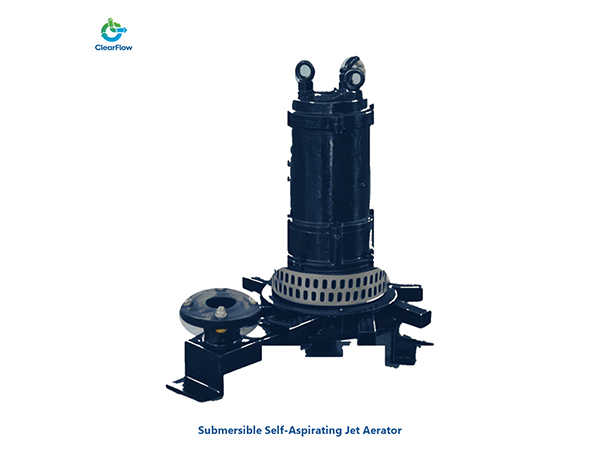
The Submersible Self-Aspirating Jet Aerator is an efficient wastewater aeration and mixing device that combines oxygen transfer and water circulation in one compact unit. It uses a high-speed impeller to create suction, drawing air from above the water surface through an intake pipe. The air is mixed with water inside the impeller and discharged as a radial jet of fine bubbles.
Unlike conventional aeration systems, this self-aspirating jet aerator does not require an external blower, compressor or air distribution pipeline. Its compact submerged design simplifies installation, reduces system complexity and makes it suitable for both new wastewater treatment projects and the upgrading of existing tanks.
Available in power ratings from 0.75 kW to 22 kW, ClearFlow submersible self-aspirating jet aerators can be selected according to tank dimensions, water depth, aeration requirements and wastewater characteristics.
Working Principle
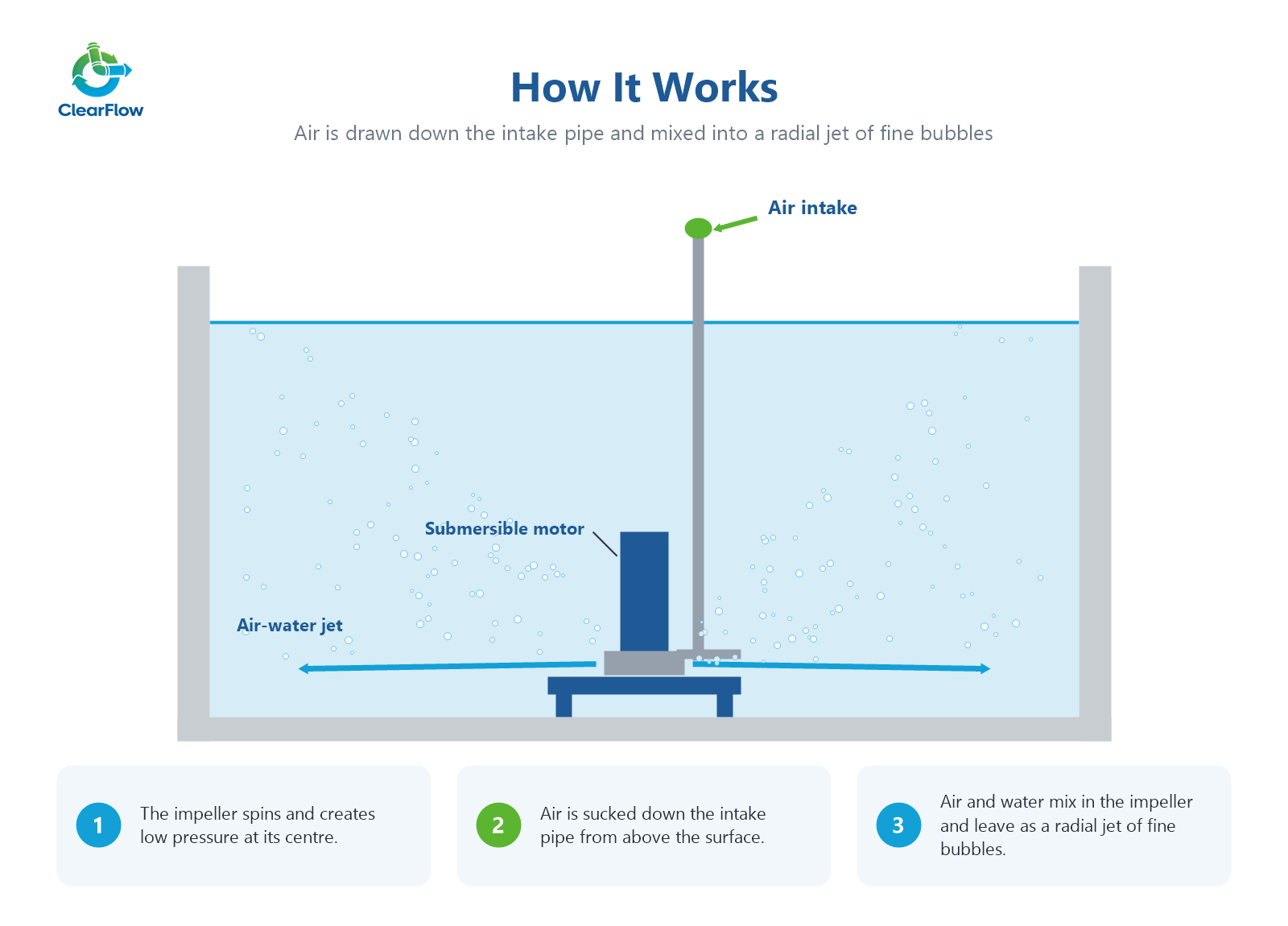
The submersible self-aspirating jet aerator works through a self-aspiration and radial jet discharge process:
Impeller Rotation: The motor drives the impeller at high speed, creating a low-pressure area at the impeller inlet.
Air Intake: The pressure difference draws atmospheric air down through the intake pipe from above the water surface.
Gas-Liquid Mixing: Air enters the impeller chamber and mixes with the surrounding water under high-speed rotation.
Radial Jet Discharge: The air-water mixture is discharged outward as a radial jet containing fine bubbles, providing oxygen transfer and water mixing simultaneously.
This integrated process helps maintain water circulation, keep suspended solids moving and improve aeration conditions without a separate air supply system.
Key Features and Benefits
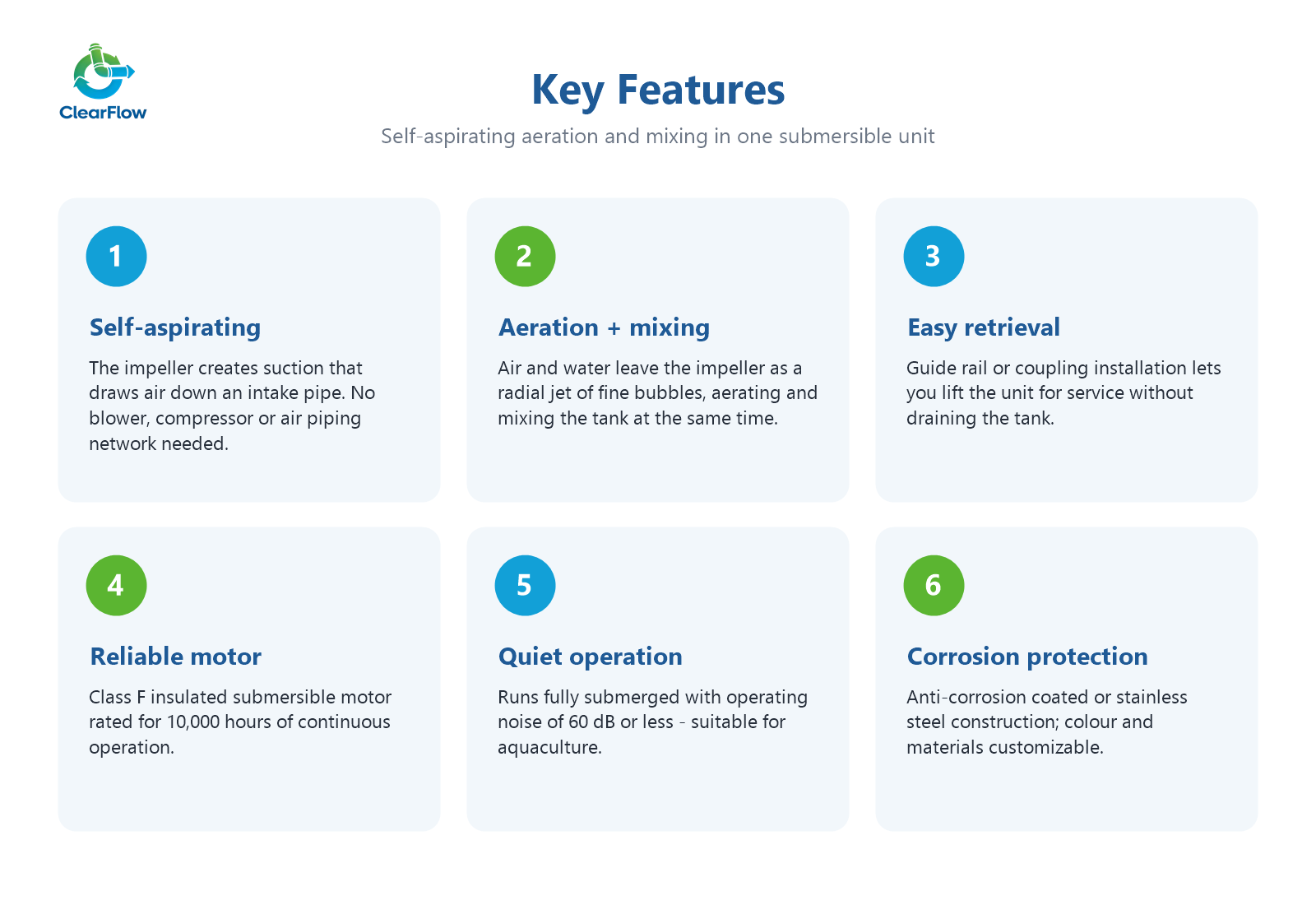
1. Self-Aspirating Design – No External Blower Required
The impeller generates suction to draw air directly from above the water surface. No separate blower, compressor or air distribution pipeline is needed, reducing equipment requirements and installation complexity.
2. Combined Aeration and Mixing
The radial jet of air-water mixture distributes fine bubbles while generating water circulation. This helps improve oxygen transfer, keep suspended solids in motion and reduce dead zones in the tank.
3. Easy Installation and Retrieval
The unit can be installed using a guide rail or coupling system. It can be lifted for inspection, maintenance or replacement without draining the entire tank, helping reduce maintenance downtime.
4. Reliable Motor Performance
The motor features Class F insulation and is designed for continuous operation, with a rated operating life of up to 10,000 hours under specified operating conditions.
5. Low-Noise Submerged Operation
With the motor and impeller operating underwater, the equipment produces an operating noise level of 60 dB or less, helping reduce noise around wastewater treatment facilities.
6. Corrosion-Resistant Construction
Available with anti-corrosion coated or stainless steel construction to suit different water conditions. Material options and equipment colors can be customized according to project requirements.
Technical Parameters
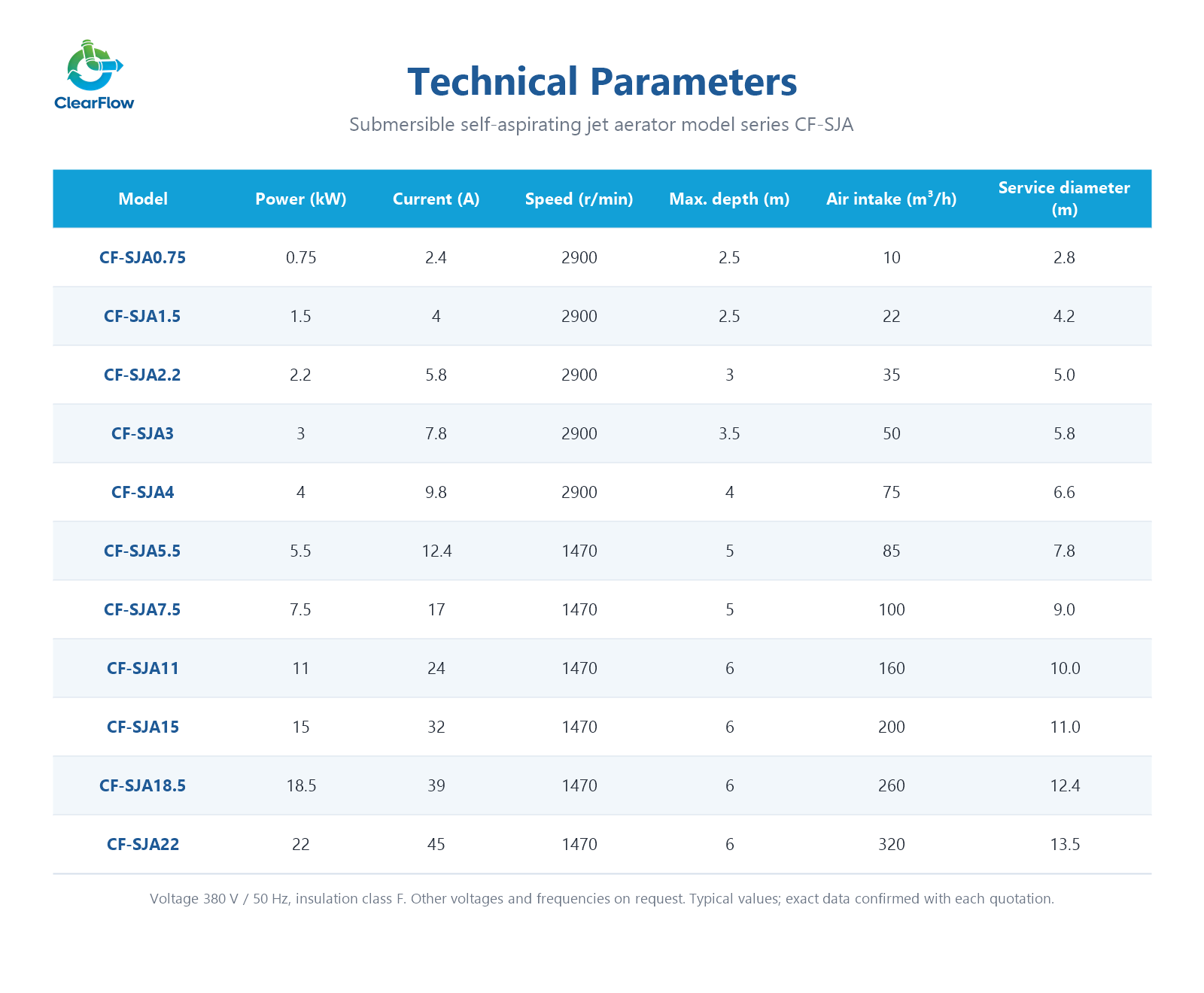
Standard Power Supply: 380 V / 50 Hz
Motor Insulation Class: Class F
Customization: Other voltages and frequencies are available upon request.
Note: The values listed above are typical reference data. Actual specifications should be confirmed with ClearFlow when requesting a quotation.
Main Applications
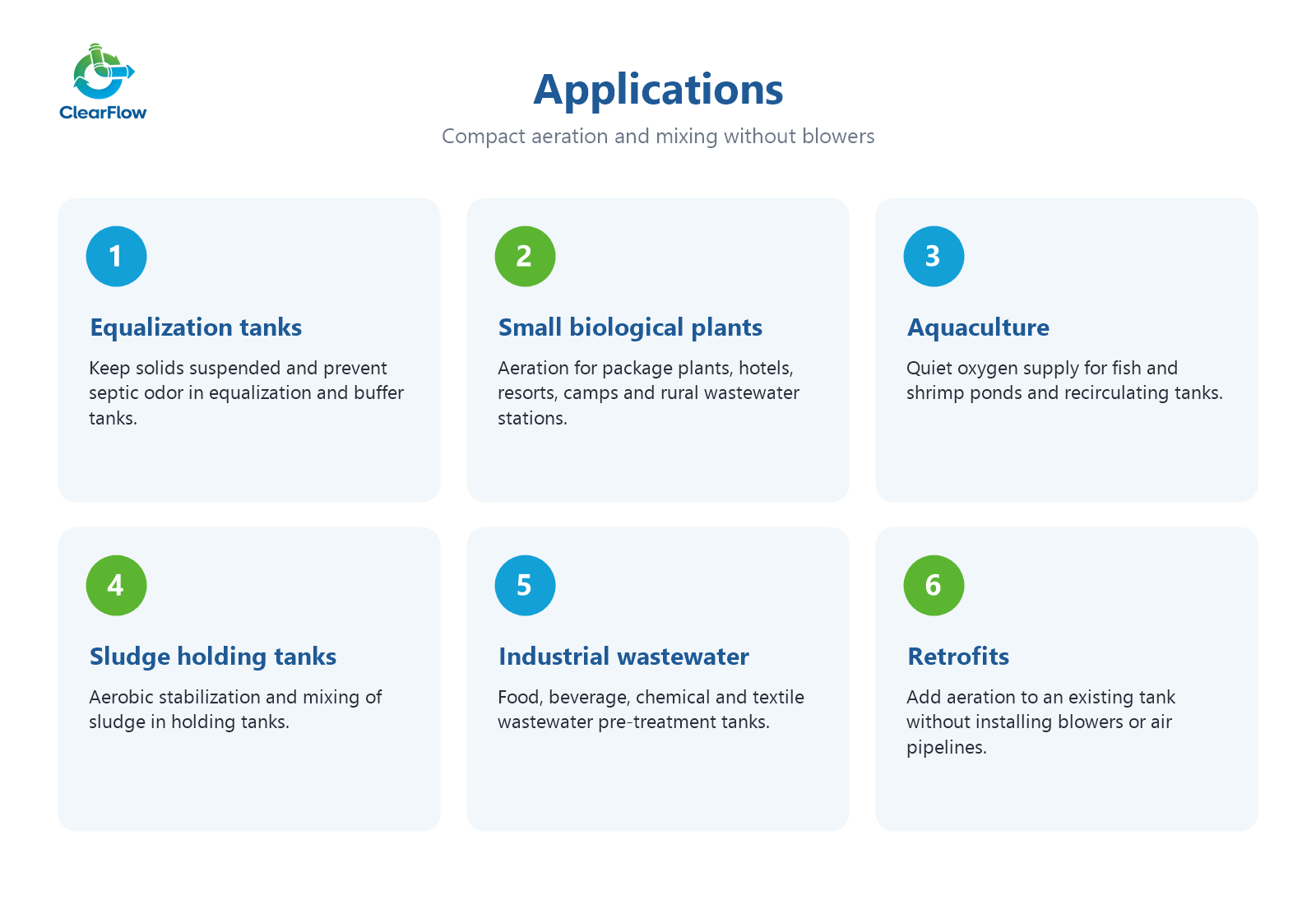
The submersible self-aspirating jet aerator is suitable for wastewater treatment, aquaculture and industrial water treatment applications that require both aeration and mixing.
1. Equalization and Buffer Tanks
Provides aeration and water circulation in equalization tanks, helping keep suspended solids moving and reduce the formation of stagnant zones and septic conditions.
2. Package Wastewater Treatment Plants
Suitable for compact wastewater treatment systems in hotels, resorts, camps, rural communities and other decentralized wastewater treatment facilities.
3. Aquaculture Systems
Used in fish ponds, shrimp ponds and recirculating aquaculture systems to provide supplemental aeration and improve water circulation.
4. Sludge Holding Tanks
Helps maintain sludge suspension and reduce sediment accumulation in sludge storage and holding tanks.
5. Industrial Wastewater Pre-Treatment
Can be used in wastewater pre-treatment and equalization processes in food and beverage, chemical and textile industries.
6. Existing Wastewater Treatment Tank Upgrades
An option for adding aeration and mixing to existing tanks where installing external blowers and air distribution pipelines is difficult or undesirable.
How to Select the Right Submersible Jet Aerator
Selecting the appropriate model requires consideration of the tank structure, water conditions and treatment requirements.
Before recommending a model, ClearFlow engineers can evaluate the following information:
Tank dimensions: Length, width, diameter and total volume of the tank.
Water depth: Actual operating water depth and maximum installation depth.
Wastewater characteristics: Municipal wastewater, industrial wastewater, aquaculture water or sludge.
Aeration requirements: Required dissolved oxygen level and oxygen demand.
Mixing requirements: Whether the main purpose is aeration, suspension or combined aeration and mixing.
Installation conditions: Existing tank layout, available lifting equipment and electrical supply.
Send us your project details to receive a suitable model recommendation and quotation.
Frequently Asked Questions
Q1: What is a submersible self-aspirating jet aerator?
A submersible self-aspirating jet aerator is a wastewater treatment device that combines aeration and mixing. Its impeller creates suction to draw air from above the water surface, mixes it with water and discharges the mixture as a radial jet of fine bubbles.
Q2: Does a self-aspirating jet aerator require an external blower?
No. The equipment draws air through its own intake pipe using the suction generated by the impeller. A separate blower or compressor is not required under normal operating conditions.
Q3: What is the difference between a jet aerator and a conventional surface aerator?
A jet aerator is installed underwater and draws air through an intake pipe from above the water surface. It discharges an air-water mixture as a radial jet. A conventional surface aerator operates at or near the water surface and introduces oxygen through surface agitation and water splashing.
Q4: Can the aerator provide both oxygenation and mixing?
Yes. The radial discharge of the air-water mixture provides aeration while generating water circulation. It can help keep suspended solids moving and improve mixing throughout the tank.
Q5: Can it be installed in an existing wastewater treatment tank?
Yes. It can be used in existing tanks to add aeration and mixing without installing a complete external blower and air pipeline system. Actual installation suitability depends on tank structure and operating conditions.
Q6: Is the equipment easy to maintain?
Yes. With a guide rail or coupling installation system, the unit can be lifted from the tank for inspection and maintenance without draining the entire tank.
Q7: What materials are available?
The equipment is available with anti-corrosion coated or stainless steel construction. Specific material options should be confirmed according to the wastewater composition and project requirements.
Q8: What power supply does the aerator require?
The standard power supply is 380 V / 50 Hz. Other voltage and frequency configurations can be provided upon request.
Q9: What information is needed to select a suitable model?
The main information includes tank dimensions, water depth, wastewater type, required aeration and mixing performance, and available power supply. ClearFlow engineers can use these details to recommend a suitable model.
Q10: Can ClearFlow provide customized aeration solutions?
Yes. ClearFlow can recommend suitable equipment configurations according to project conditions, including model selection, material options and installation arrangements.
Why Choose ClearFlow?
ClearFlow provides aeration equipment and wastewater treatment solutions for municipal and industrial applications. We focus on matching equipment selection to actual project conditions rather than simply recommending a standard model.
Multiple models covering power ratings from 0.75 kW to 22 kW
Equipment selection based on tank dimensions and operating conditions
Corrosion-resistant material options
Custom voltage and frequency configurations
Technical support for equipment selection and installation
Request a Free Aerator Selection
Looking for a reliable Submersible Self-Aspirating Jet Aerator for your wastewater treatment or aquaculture project?
Send ClearFlow your tank dimensions, water depth and wastewater type through the inquiry form or WhatsApp. Our engineering team will help select a suitable model and provide a quotation.
WhatsApp: +86-13312924513
Our team will respond within 24 hours.