

Industrial Wastewater Treatment Aerator
1. Product Overview
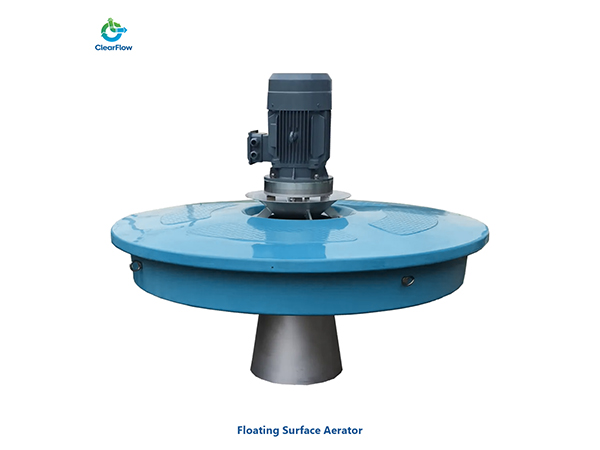
ClearFlow Floating Surface Aerators are designed for efficient oxygen transfer and water circulation in municipal wastewater treatment plants, industrial wastewater treatment facilities, and aquaculture ponds.
The floating aerator works by drawing water from below the surface and spraying it into the air through a high-speed impeller. This process increases the contact between water and air, promoting oxygen transfer while creating strong water circulation and mixing.
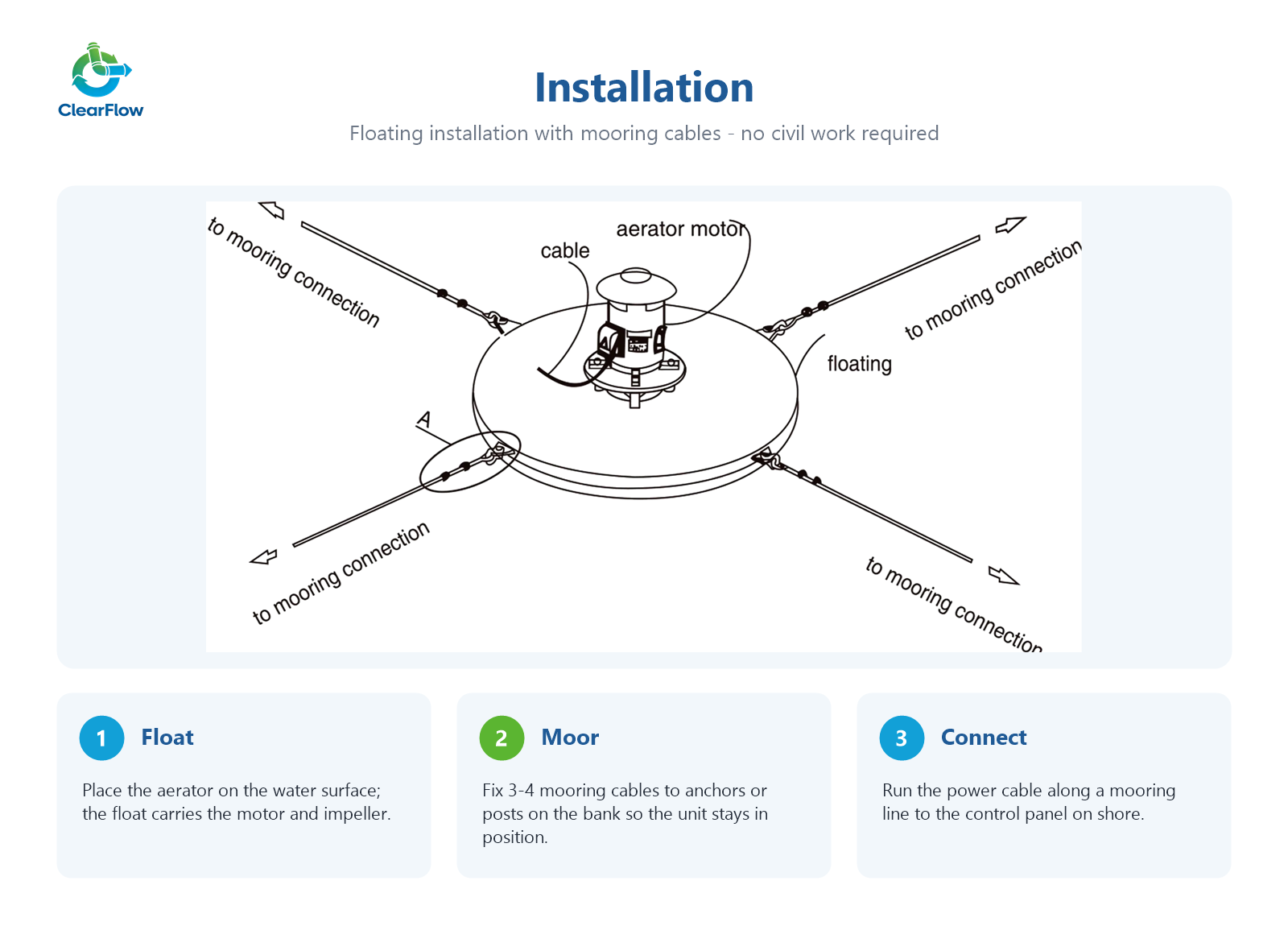
Unlike conventional aeration systems that require blowers, air pipes, and diffusers, floating surface aerators operate directly on the water surface. They are supported by floating structures and secured with mooring cables, allowing them to automatically adapt to changing water levels.
With an IE3 high-efficiency motor, direct-drive impeller, and corrosion-resistant floating structure, ClearFlow floating aerators provide a practical solution for aeration and mixing in aerated lagoons, oxidation ponds, SBR tanks, equalization basins, and large aquaculture ponds.
Available motor power ranges from 5.5 kW to 22 kW, with customized configurations available according to project requirements.
2. Product Details and Key Features
2.1 High Oxygen Transfer Efficiency
The floating surface aerator lifts large volumes of water from below the surface and sprays it into the air, increasing the contact area between water and atmospheric oxygen.
This surface aeration process promotes oxygen dissolution and improves water circulation throughout the treatment basin.
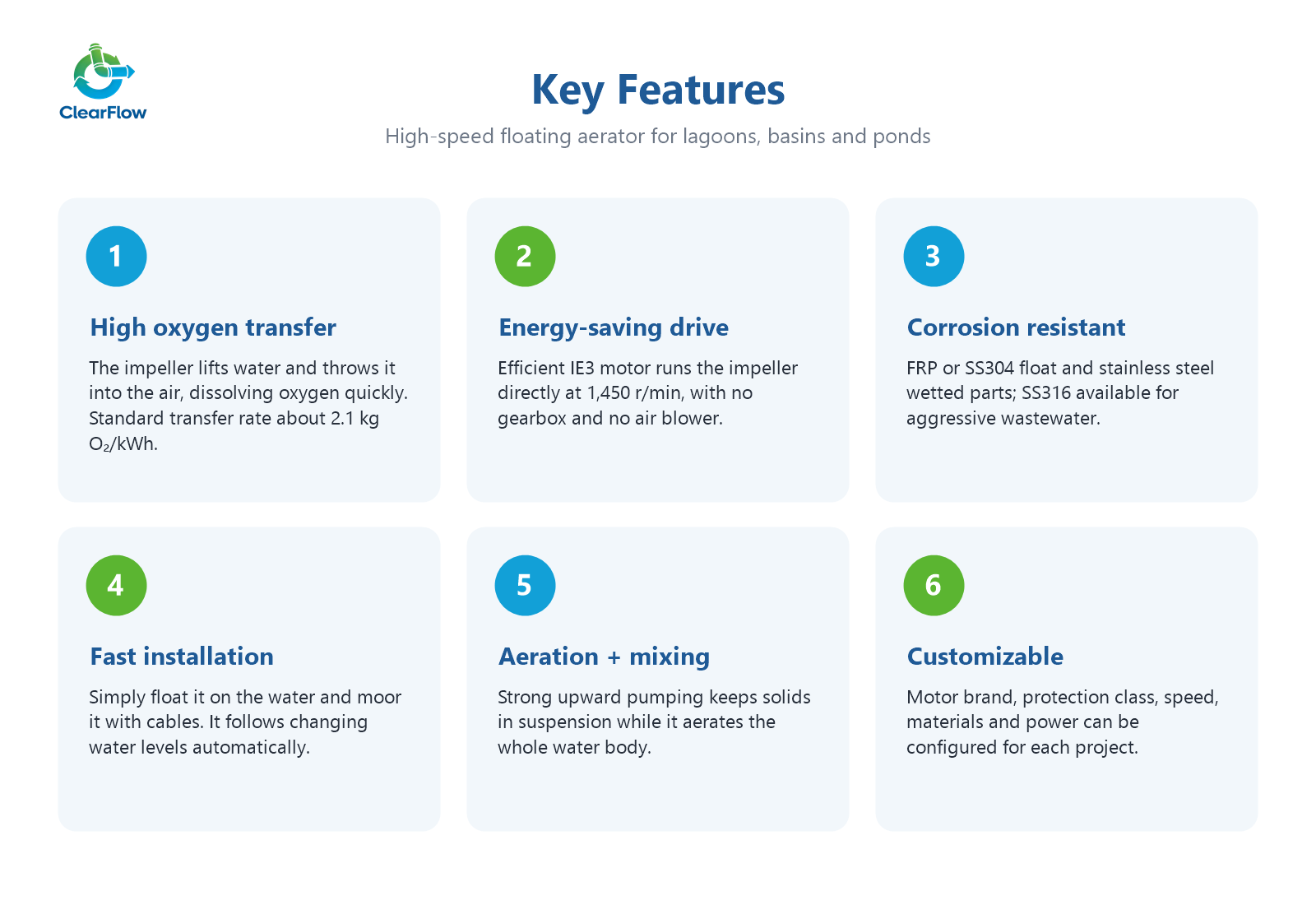
Standard oxygen transfer rate: approximately 2.1 kg O₂/kWh (3.5 lb O₂/hp·h) in clean water.
Large water pumping capacity.
Continuous surface aeration and water circulation.
Suitable for wastewater treatment ponds and large water bodies.
Actual oxygen transfer performance depends on water temperature, wastewater characteristics, dissolved solids, and operating conditions. The stated value is a typical clean-water reference.
2.2 Energy-Efficient Direct-Drive Design
The aerator uses an IE3 high-efficiency motor that directly drives the impeller at 1,450 r/min.
Unlike systems that require additional mechanical transmission components, the direct-drive structure eliminates the gearbox.
Key advantages include:
Reduced mechanical transmission losses.
No gearbox required.
No external blower required.
Simplified mechanical structure.
Convenient operation and maintenance.
2.3 Floating Design for Changing Water Levels
The equipment is supported by a floating structure made of FRP or SS304 stainless steel, allowing it to operate at different water levels.
The floating design provides several advantages:
Automatically follows changes in water levels.
No fixed installation platform required.
Suitable for ponds and open treatment basins.
Installation using simple mooring cables.
Convenient relocation and maintenance.
The equipment can be installed directly on the water surface without draining the pond or basin, provided the installation and anchoring conditions are suitable.
2.4 Aeration and Mixing in One Unit
In addition to oxygen transfer, the floating surface aerator provides strong water pumping and circulation.
The upward water flow helps keep suspended solids in motion and reduces sediment accumulation in suitable applications.
Its combined aeration and mixing functions make it suitable for:
Aerated lagoons.
Equalization tanks.
Oxidation ponds.
Industrial wastewater treatment ponds.
Large aquaculture ponds.
2.5 Corrosion-Resistant Materials
To accommodate different water treatment environments, ClearFlow floating surface aerators offer multiple material configurations.
Float material: FRP or SS304 stainless steel.
SS316 stainless steel available as an option.
Stainless steel wetted components.
Motor protection class: IP56.
Material selection can be customized according to wastewater composition, operating environment, and project requirements.
2.6 Easy Installation and Flexible Configuration
The floating surface aerator features a simple installation structure.
The equipment is placed on the water surface and secured with mooring cables. It can follow changing water levels without requiring a fixed-height installation platform.
ClearFlow also offers customized configurations based on project requirements, including:
Motor brand.
Motor protection class.
Operating speed.
Float material.
Stainless steel grade.
Motor power and equipment quantity.
3. Technical Specifications
ClearFlow floating surface aerators are available in several models to accommodate different pond sizes, water depths, and aeration requirements.
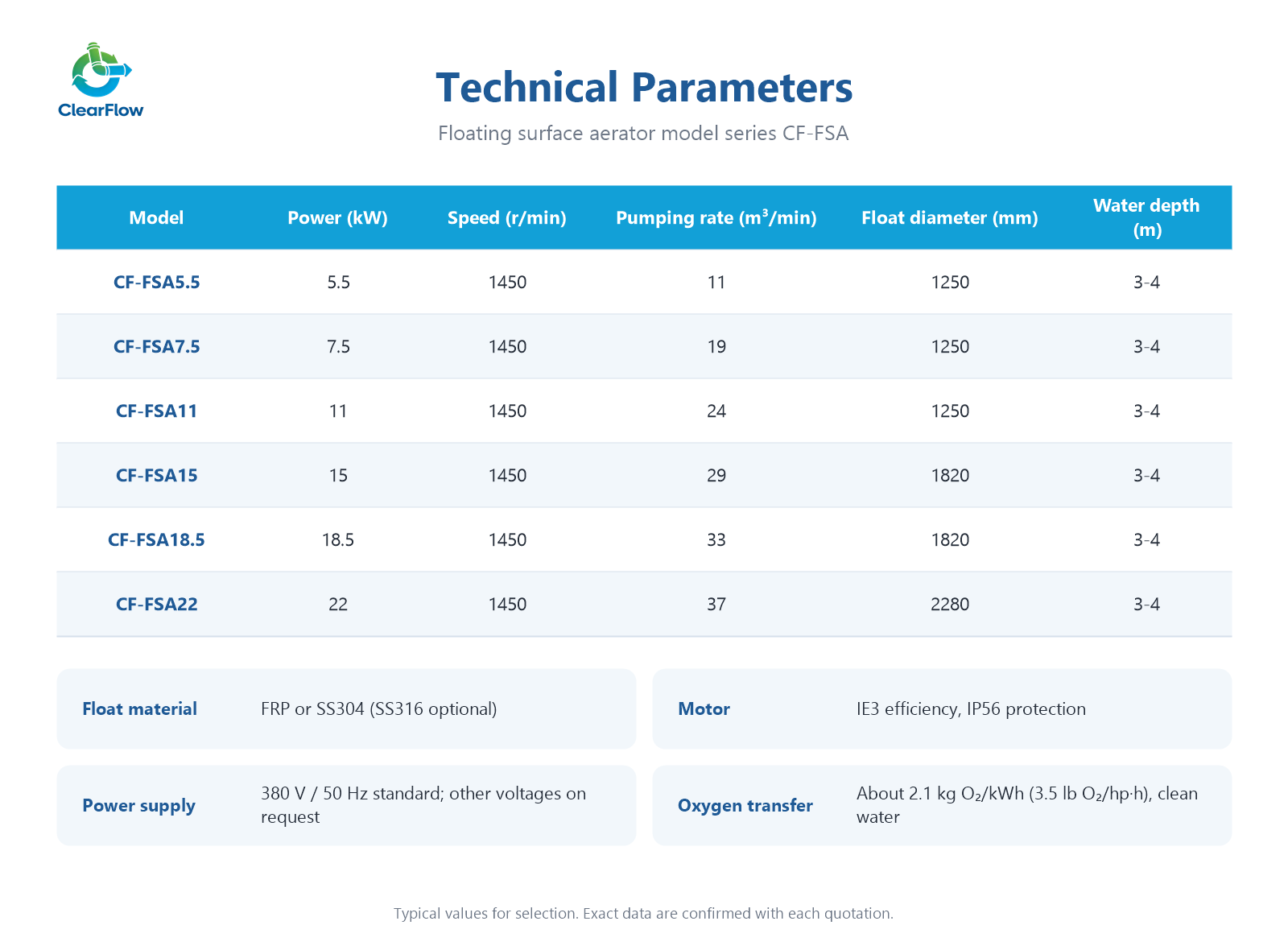
Note: The above specifications are typical reference values. Actual equipment configurations and performance parameters should be confirmed with each quotation. Other voltages, motor brands, materials, and configurations are available upon request.
4. Applications of Floating Surface Aerators
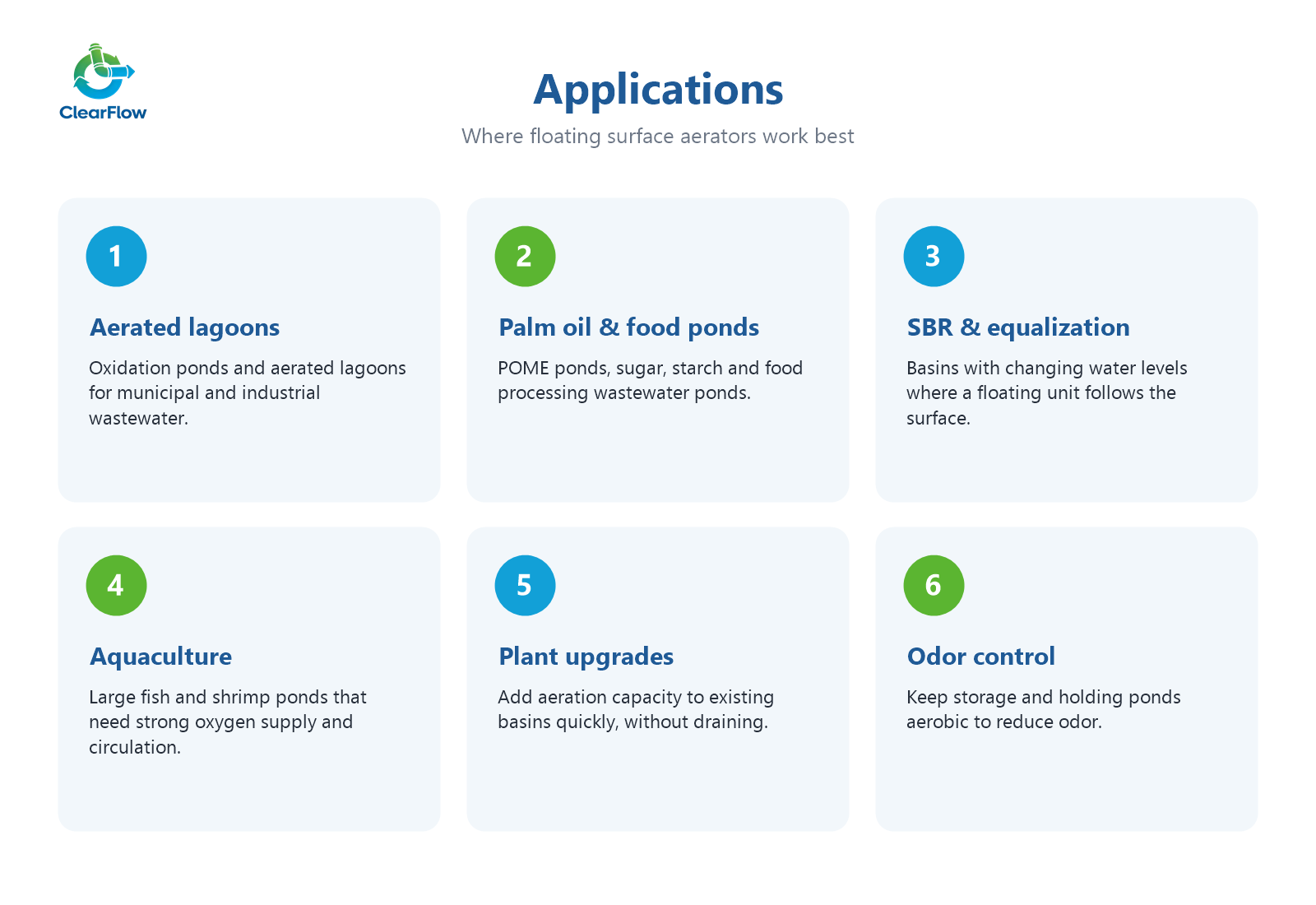
ClearFlow floating surface aerators are suitable for various municipal, industrial, and aquaculture applications requiring oxygen transfer and water circulation.
4.1 Municipal Wastewater Treatment
Used in aerated lagoons and oxidation ponds to supply oxygen and promote biological wastewater treatment.
Typical applications:
Municipal wastewater aeration ponds.
Oxidation ponds.
Aerated lagoons.
Wastewater treatment facilities.
4.2 Industrial Wastewater Treatment
Suitable for industrial wastewater ponds where aeration and mixing are required to support biological treatment and improve water circulation.
Common applications include:
Palm oil mill effluent (POME) treatment.
Food processing wastewater.
Sugar industry wastewater.
Starch processing wastewater.
Industrial wastewater equalization ponds.
4.3 SBR and Equalization Basins
Floating surface aerators can be installed in sequencing batch reactor (SBR) systems and equalization basins where water levels fluctuate.
Their floating structure allows the equipment to adapt to changing water levels while providing aeration and mixing.
4.4 Aquaculture and Fish Farming
In large fish and shrimp ponds, floating surface aerators help increase dissolved oxygen and circulate pond water.
Typical applications:
Fish farming ponds.
Shrimp farming ponds.
Large aquaculture facilities.
Aquaculture water circulation systems.
Proper equipment selection and placement help maintain suitable dissolved oxygen conditions for aquatic organisms.
4.5 Existing Wastewater Pond Upgrades
For existing treatment ponds that require additional aeration capacity, floating surface aerators provide a convenient installation option.
They can be added to suitable existing ponds without draining the entire basin or constructing a new fixed installation platform.
4.6 Odor Control in Storage Ponds
Insufficient oxygen and poor water circulation can contribute to anaerobic conditions in wastewater storage ponds.
Floating surface aerators can help improve oxygen availability and water circulation, supporting the management of anaerobic conditions and associated odors.
Actual odor reduction depends on wastewater characteristics and the overall treatment process.
5. How to Select the Right Floating Surface Aerator
Choosing the appropriate floating surface aerator requires an assessment of the water body and its treatment requirements.
To recommend a suitable model, ClearFlow engineers need the following information:
Pond or basin dimensions: Surface area, length, width, and average water depth.
Water flow rate: Daily wastewater treatment capacity (m³/day).
Wastewater characteristics: BOD, COD, suspended solids, and wastewater type.
Dissolved oxygen requirements: Target DO concentration (mg/L).
Installation conditions: Water level variations, pond layout, and available electrical supply.
Based on this information, we can recommend the appropriate motor power, equipment quantity, and installation layout.
6. Frequently Asked Questions
Q1: What is a floating surface aerator?
A floating surface aerator is a mechanical aeration device installed directly on the water surface. It uses a motor-driven impeller to lift water and spray it into the air, increasing oxygen transfer while promoting water circulation and mixing.
Q2: How does a floating surface aerator work?
The motor drives the impeller at high speed, drawing water from below the surface and discharging it into the air. The water droplets come into contact with atmospheric oxygen before returning to the pond, promoting oxygen transfer and water mixing.
Q3: What is the oxygen transfer rate of a floating surface aerator?
The typical standard oxygen transfer rate of ClearFlow floating surface aerators is approximately 2.1 kg O₂/kWh (3.5 lb O₂/hp·h) in clean water.
Actual oxygen transfer rates in wastewater may differ depending on water quality, temperature, dissolved solids, and operating conditions.
Q4: What is the difference between a floating surface aerator and a submersible aerator?
A floating surface aerator operates on the water surface and transfers oxygen by spraying water into the air.
A submersible aerator operates below the water surface and uses a submerged mixing and aeration mechanism.
Floating surface aerators are particularly suitable for open ponds, aerated lagoons, and basins with changing water levels.
Q5: Does a floating surface aerator require an air blower or diffuser?
No. The floating surface aerator uses a motor-driven impeller to achieve surface aeration. It does not require an external air blower or air distribution piping system.
Q6: Can floating surface aerators operate at changing water levels?
Yes. The floating structure allows the equipment to move with changing water levels. Mooring cables keep the equipment in its designated operating area.
Q7: What materials are available for the floating structure?
Standard float materials include FRP and SS304 stainless steel. SS316 stainless steel is also available for applications requiring additional corrosion resistance.
Q8: Can floating surface aerators be used in aquaculture ponds?
Yes. They are suitable for large fish and shrimp ponds where additional oxygen transfer and water circulation are required.
The installation quantity and layout should be determined according to pond size, stocking density, water quality, and dissolved oxygen requirements.
Q9: How many floating surface aerators are needed for a wastewater pond?
The required quantity depends on the pond surface area, water depth, wastewater flow rate, BOD or COD loading, and target dissolved oxygen concentration.
ClearFlow engineers can recommend an appropriate configuration after reviewing the project information.
Q10: Does ClearFlow provide customized floating surface aerators?
Yes. ClearFlow can customize motor brands, motor power, protection class, operating speed, float materials, and other configurations according to project requirements.
7. Get a Free Floating Aerator Selection
Looking for a floating surface aerator for your wastewater treatment pond, aerated lagoon, SBR system, or aquaculture project?
ClearFlow provides equipment selection support based on your actual water treatment conditions.
Please send us the following information:
Pond or basin dimensions.
Average water depth.
Daily wastewater flow rate.
BOD or COD values.
Required dissolved oxygen level.
Wastewater or application type.
Our engineering team will review your requirements and recommend suitable aerator models, quantities, and installation layouts.
Contact ClearFlow today for a free aerator selection and technical consultation.
WhatsApp: +86-13312924513
Our team will respond to your inquiry within 24 hours.