

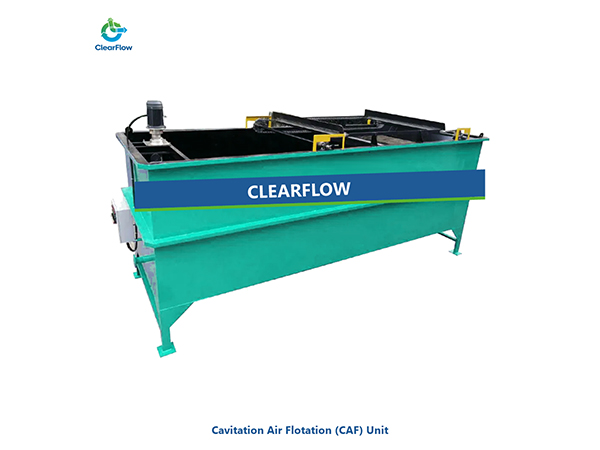
The Cavitation Air Flotation (CAF) Unit is a wastewater treatment system designed to remove oil, grease, suspended solids and colloidal pollutants from industrial and municipal wastewater.
It uses a high-speed cavitation aerator to draw in atmospheric air and generate fine bubbles through a cavitation and gas-liquid mixing process. These bubbles attach to suspended particles, oil droplets and other contaminants, helping them rise to the water surface for separation and removal by a mechanical scraper.
Unlike conventional dissolved air flotation (DAF) systems, the CAF unit does not require a separate air compressor, saturator or recycle pump. Its integrated design simplifies equipment configuration and can reduce energy consumption and installation requirements.
ClearFlow offers multiple CAF models with treatment capacities ranging from 5 to 500 m³/h, suitable for different wastewater treatment scales and industrial applications.
Working Principle
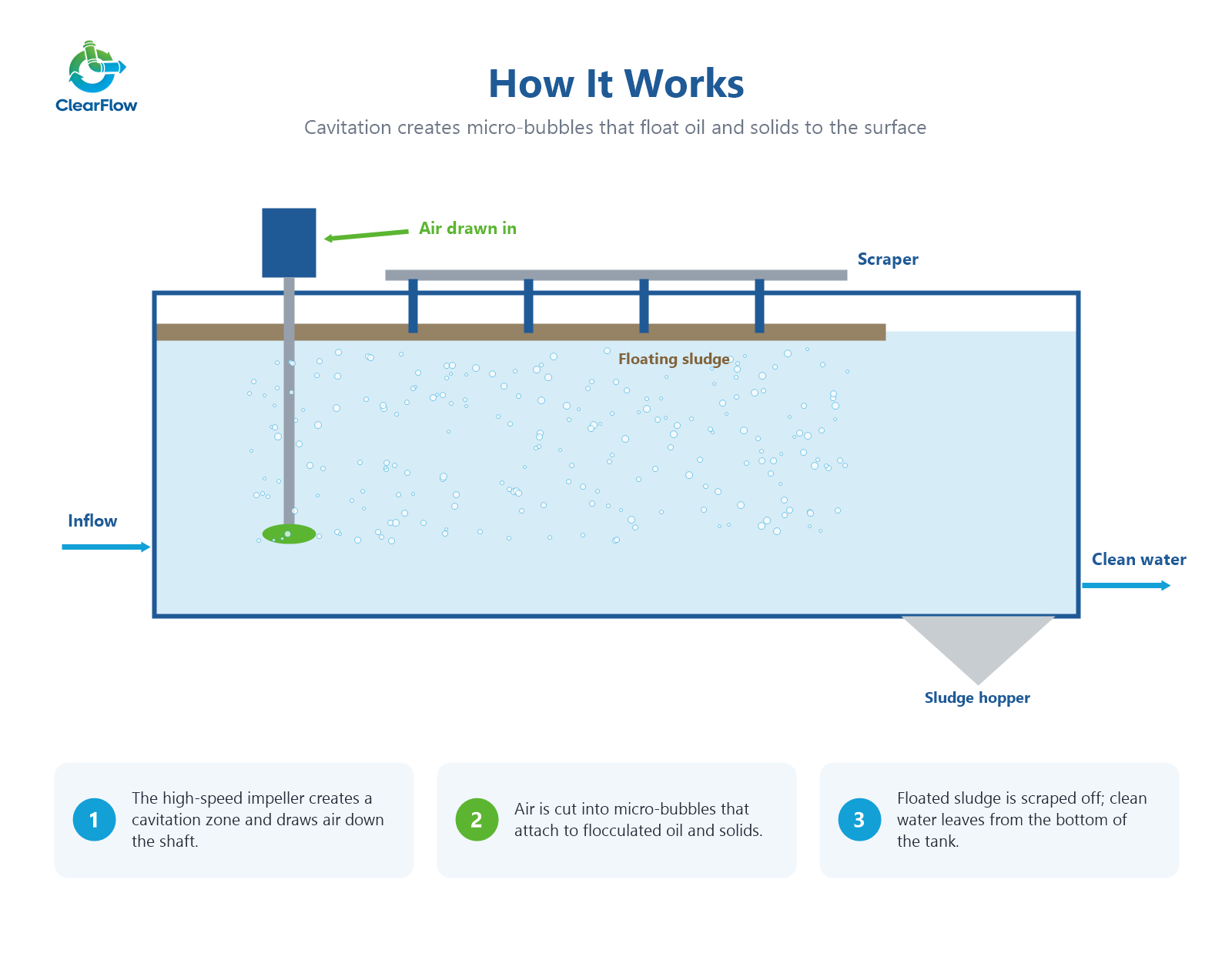
The cavitation air flotation process combines air intake, micro-bubble generation, flotation separation and mechanical sludge removal.
Air Self-Aspiration: The high-speed cavitation aerator draws atmospheric air into the wastewater without requiring an external air compressor.
Micro-Bubble Generation: The aerator disperses the incoming air into fine bubbles through its cavitation and gas-liquid mixing structure.
Flotation Separation: Fine bubbles attach to oil droplets, suspended solids and colloidal particles, forming bubble-particle aggregates that rise toward the water surface.
Surface Scraping: A mechanical scraper removes the floating contaminants and transfers them into the sludge collection hopper.
Treated Water Discharge: Separated water flows out of the flotation unit for subsequent treatment or discharge, depending on the overall treatment process.
Key Features and Benefits
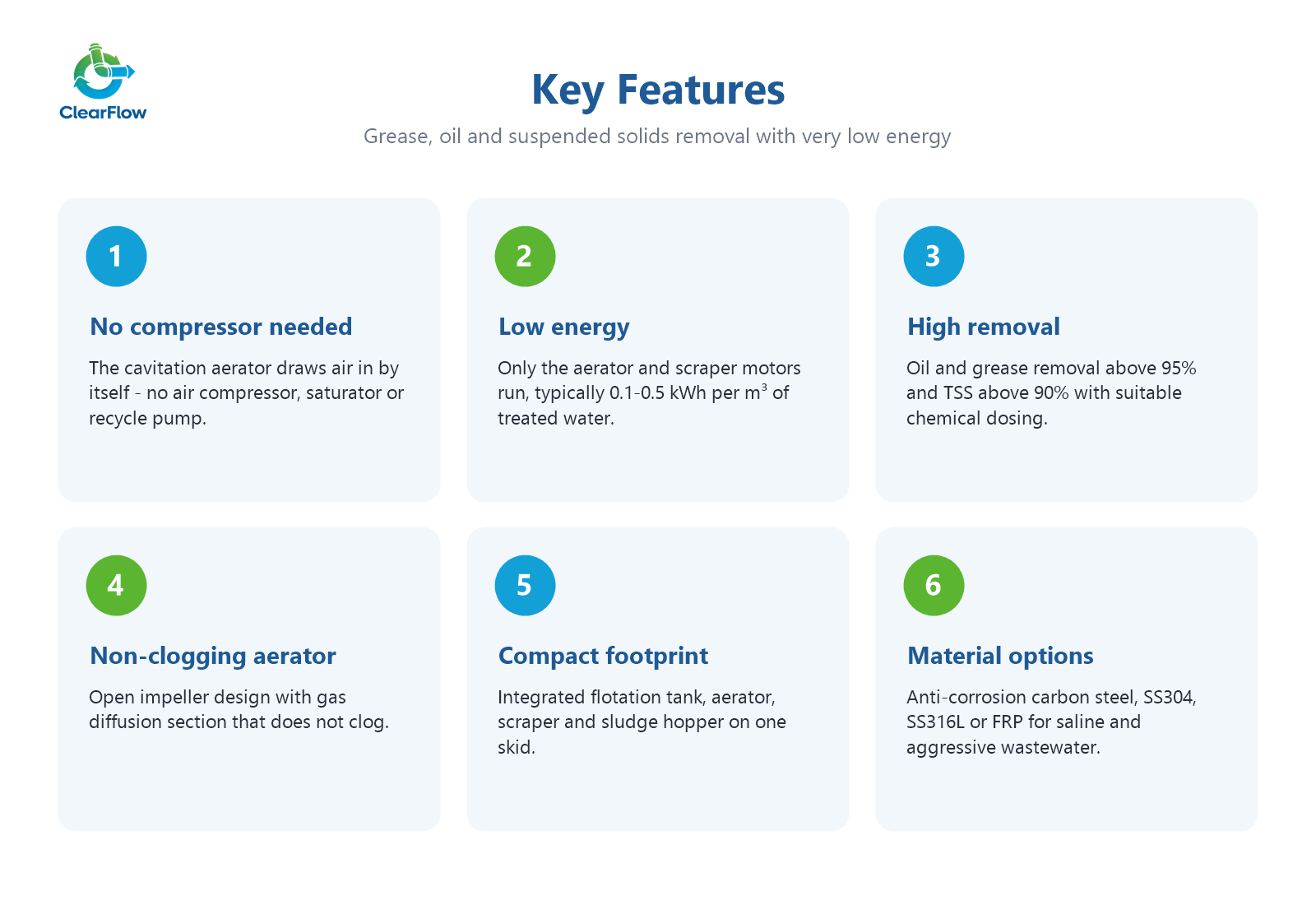
1. No External Air Compressor Required
The high-speed cavitation aerator draws in air by itself. No separate air compressor, saturator or recycle pump is required, reducing the number of auxiliary components.
2. Low Energy Consumption
The system mainly operates through the cavitation aerator and mechanical scraper motors. Typical energy consumption is approximately 0.1–0.5 kWh per m³ of treated water, depending on operating conditions and wastewater characteristics.
3. Effective Oil and Suspended Solids Removal
The fine bubbles promote the separation of oil droplets, suspended solids and colloidal particles. Under suitable wastewater conditions and chemical dosing, the stated removal performance can reach:
Oil and Grease Removal: Above 95%
Total Suspended Solids (TSS) Removal: Above 90%
COD Removal: Approximately 30–80% with chemical treatment, subject to jar testing
Actual removal efficiency depends on wastewater composition, influent concentration, chemical selection, dosage and operating conditions.
4. Non-Clogging Cavitation Aerator
The equipment uses an open impeller with a gas diffusion section to support air intake and bubble generation while reducing the risk of clogging during operation.
5. Compact Integrated Design
The flotation tank, cavitation aerator, mechanical scraper and sludge collection hopper are integrated into one equipment system. This compact configuration simplifies transportation, installation and operation.
6. Multiple Material Options
The equipment can be manufactured using anti-corrosion coated carbon steel, SS304 stainless steel, SS316L stainless steel or FRP, depending on wastewater characteristics and project requirements.
Technical Parameters
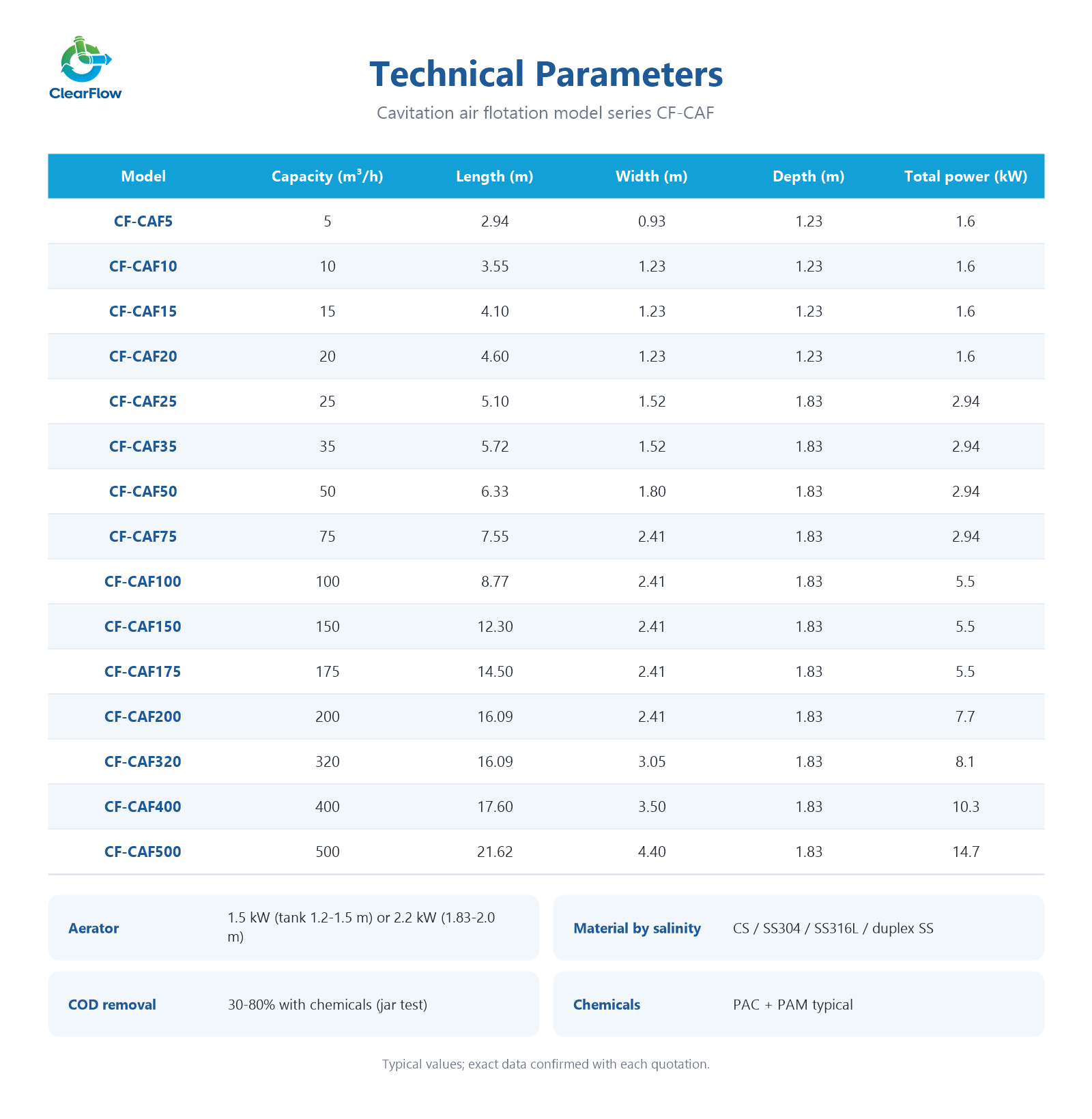
Note: The above table contains the 11 models provided in the current specification. The complete 15-model selection is available in the product specification image. Final equipment configuration and dimensions should be confirmed according to project requirements.
Chemical Treatment and Removal Performance
For wastewater containing emulsified oils, fine suspended solids or colloidal pollutants, chemical conditioning can improve flotation performance.
Commonly used chemicals include:
PAC (Polyaluminum Chloride): Helps destabilize colloidal particles and promote floc formation.
PAM (Polyacrylamide): Helps aggregate smaller particles into larger flocs, improving separation during flotation.
The appropriate chemical type and dosage should be determined through jar testing based on actual wastewater characteristics.
COD removal can typically range from 30% to 80% with suitable chemical treatment, but the actual result depends on the wastewater composition and the proportion of pollutants that can be removed by flotation.
Main Applications
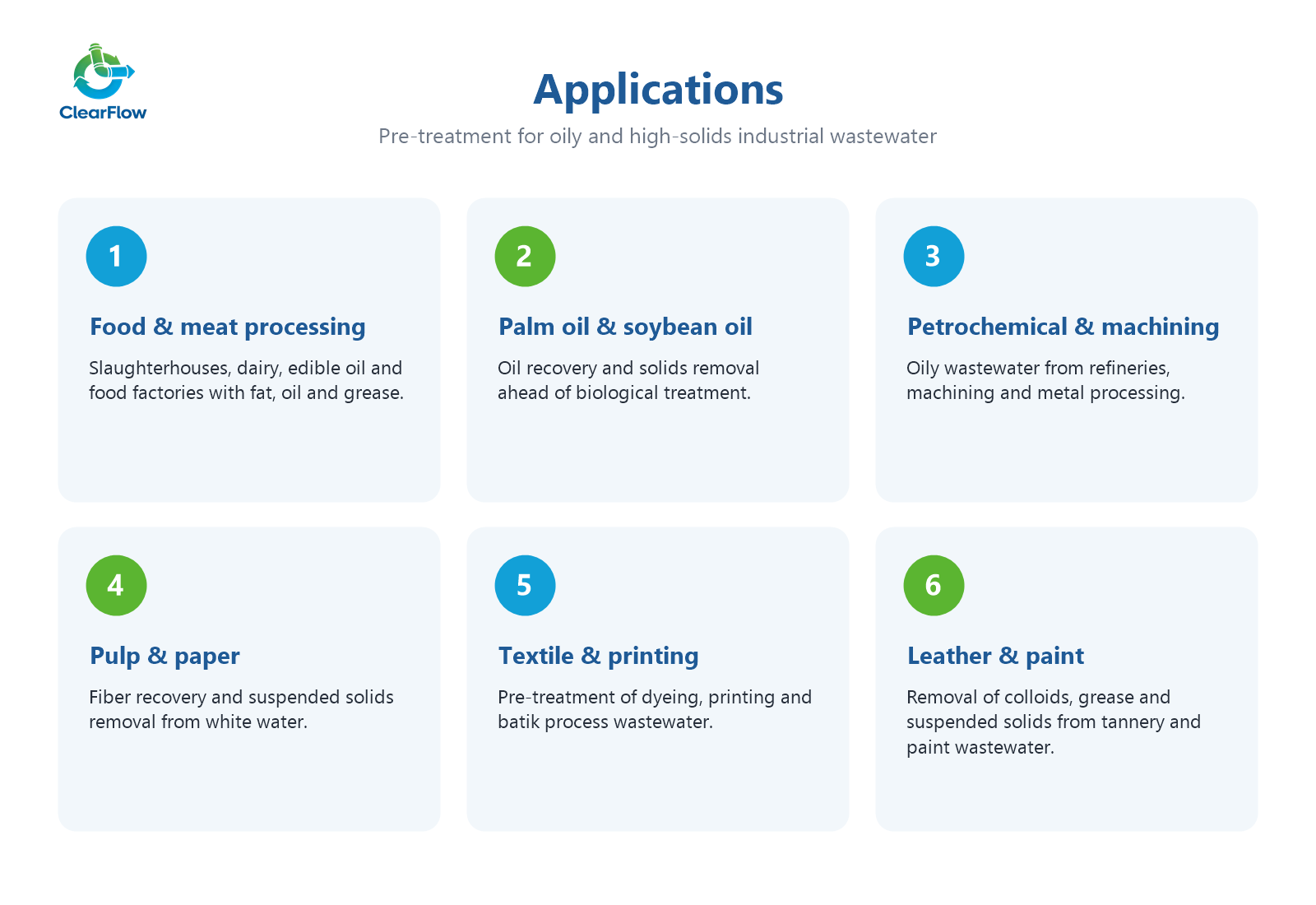
The Cavitation Air Flotation Unit is suitable for industrial wastewater containing oil, grease, suspended solids and colloidal pollutants.
1. Food and Meat Processing Wastewater
Used for removing fats, oils, grease and suspended organic solids from wastewater generated during food processing, meat processing and slaughterhouse operations.
2. Palm Oil and Soybean Oil Processing
Suitable for separating oil droplets, grease and suspended solids from wastewater produced during vegetable oil extraction and processing.
3. Petrochemical and Machining Wastewater
Used for oil-water separation and removal of suspended contaminants from wastewater generated by petrochemical facilities, metalworking and machining operations.
4. Pulp and Paper Industry
Suitable for removing suspended fibers, fine particles and other flotation-separable contaminants from pulp and paper wastewater.
5. Textile and Printing Wastewater
Can be used as a pre-treatment process to remove suspended solids, colloidal matter and certain flotation-separable pollutants from textile dyeing and printing wastewater.
6. Leather Processing Wastewater
Suitable for pre-treatment of wastewater containing suspended solids, grease and other pollutants generated during leather processing.
7. Paint and Coating Wastewater
Used for separating suspended paint particles, pigments and other flotation-separable contaminants from industrial wastewater.
Frequently Asked Questions
Q1: What is a Cavitation Air Flotation (CAF) Unit?
A CAF unit is a wastewater treatment device that uses a cavitation aerator to generate fine air bubbles. The bubbles attach to oil droplets and suspended particles, allowing them to float to the water surface for mechanical removal.
Q2: Does a CAF system require an air compressor?
No. The cavitation aerator draws in atmospheric air by itself. A separate air compressor, saturator or recycle pump is not required in the standard configuration.
Q3: What is the difference between CAF and DAF?
Both CAF and DAF use bubbles to separate suspended pollutants from water, but their air supply and bubble-generation methods are different.
CAF: Uses a high-speed cavitation aerator to draw in air and generate fine bubbles.
DAF: Commonly uses pressurized air dissolution and a recycle water system to generate flotation bubbles.
The appropriate system depends on wastewater characteristics, treatment capacity, separation requirements and project conditions.
Q4: What pollutants can a CAF unit remove?
It is mainly used to remove oil, grease, suspended solids and colloidal particles. Its performance for specific pollutants depends on their physical and chemical characteristics and whether they can be separated through flotation.
Q5: What is the typical removal efficiency?
Under suitable operating conditions and chemical dosing, the stated removal rates can exceed 95% for oil and grease and 90% for TSS. Actual results should be verified through wastewater testing and process evaluation.
Q6: Can a CAF unit reduce COD?
Yes. It can reduce COD by removing flotation-separable organic pollutants, oils and suspended solids. With suitable chemical dosing, COD removal may reach approximately 30–80%, depending on the wastewater characteristics and jar test results.
Q7: Which chemicals are commonly used with CAF equipment?
PAC and PAM are commonly used for coagulation and flocculation. The specific chemicals and dosage should be determined through jar testing.
Q8: What materials are available?
Available material options include anti-corrosion coated carbon steel, SS304, SS316L and FRP. The appropriate material should be selected according to wastewater composition and corrosion conditions.
Q9: What treatment capacities are available?
The currently provided model range covers 5–500 m³/h. Additional models are included in the complete 15-model product specification.
Q10: What information is needed to select a suitable CAF unit?
Please provide the following information:
Wastewater source and type
Design flow rate (m³/h)
Influent oil and grease concentration
TSS and COD concentrations
Required treatment performance
Available installation space
Wastewater sample or jar test results, if available
ClearFlow engineers can evaluate these details and recommend a suitable model and chemical treatment configuration.
Request a CAF Wastewater Treatment Solution
Looking for a cavitation air flotation system for industrial wastewater treatment or oil-water separation?
Send ClearFlow your wastewater type, treatment capacity, influent water quality and required treatment targets. Our engineers will help select a suitable CAF model and provide a technical proposal.
WhatsApp: +86-13312924513
Submit your inquiry today and our team will respond within 24 hours.