

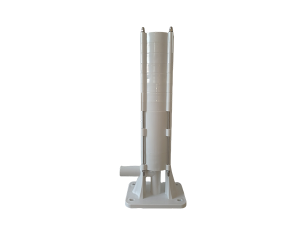
When a swirl aerator exhibits low oxygen transfer efficiency, systematic troubleshooting should be carried out from four dimensions: the equipment itself, system configuration, process operation, and maintenance status. The main troubleshooting directions and countermeasures are as follows:
1. Inspect the Condition of the Aerator Body
Although swirl aerators are less prone to clogging, problems may still occur after long-term operation:
Clogged air distribution plate pores: Accumulation of sludge or impurities blocks airflow and reduces oxygen transfer efficiency. It is recommended to flush the surface of the air distribution plate with a high-pressure water gun monthly.
Damaged internal guide vanes: Deformation or breakage of guide vanes in the swirl chamber will destroy the gas-liquid swirling mixing effect, resulting in a sharp drop in oxygen utilization. The aerator must be disassembled for inspection and the guide vane assembly replaced.
Material aging or scaling: In wastewater with high calcium content or high concentration, poor anti-scaling materials tend to form scale and impair performance. Anti-scaling products such as polymer composite materials are recommended.
2. Check the Air Supply System
Low oxygen efficiency often results from insufficient air supply or air circuit leakage:
Insufficient fan air volume / pressure: Check whether the fan delivers the designed air volume, whether the impeller is worn, and whether the drive belt is loose or broken.
Pipeline leakage or valve failure: Inspect the main air pipes, branch pipes and valves for air leakage, and whether valves are fully open. Pipe scaling or foreign blockage also increases resistance and reduces effective air volume.
Unstable inlet air pressure: Pressure fluctuations cause uneven aeration and lower oxygen transfer efficiency. Check whether the pressure stabilizing device functions properly.
3. Evaluate Process Operating Parameters
Even if the swirl aerator works normally, excessive system load may lead to failure to raise dissolved oxygen (DO):
Excessively high sludge concentration: A high MLSS greatly increases oxygen consumption, exceeding the aerator’s oxygen supply capacity. MLSS should be controlled within a reasonable range.
Sudden increase in influent load: A sharp rise in organic concentration or flow rate causes the microbial oxygen uptake rate to far exceed the oxygen supply rate.
Excessively low water temperature: Low temperature reduces microbial activity and oxygen solubility. Properly extend aeration time or raise water temperature accordingly.
Abnormal dissolved oxygen monitoring: DO probe fouling, incorrect calibration or damage may cause false “low oxygen efficiency” readings. Clean the probe and recalibrate it.
4. Verify Installation and Operating Conditions
Insufficient installation height: If the aerator is completely submerged due to excessive sludge at the bottom of the tank, raise the aerator properly to increase its installation height.
Non-vertical installation: A misaligned swirl aerator causes airflow deflection and weakens mixing performance.
Uneven aeration distribution: Uneven layout density of swirl aerators in the tank leads to insufficient oxygen supply in some zones. Optimize placement with CFD simulation to avoid “dead zones”.