

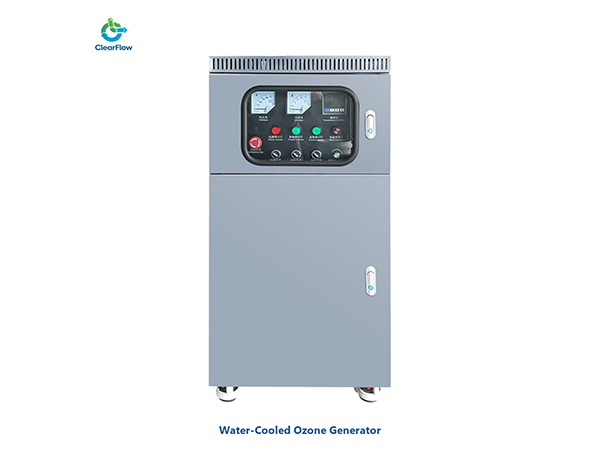
Industrial High-Concentration Ozone Generation System
1. Product Overview
ClearFlow Water-Cooled Ozone Generators are designed for industrial water treatment, wastewater treatment, disinfection, and oxidation applications that require a reliable and continuous supply of high-concentration ozone.
Using oxygen-fed ceramic plate corona discharge technology, these industrial ozone generators convert oxygen into ozone through a high-efficiency electrical discharge process. The system delivers an ozone concentration of 140–300 mg/L and offers ozone output capacities ranging from 50 g/h to 5 kg/h, with larger capacities available upon request.
Designed for 24/7 continuous operation, the water-cooled ozone generator features a double-electrode water-cooling structure that helps maintain stable operating temperatures and supports long-term performance. Its modular discharge cells, integrated protection system, and stainless steel cabinet make operation and maintenance more convenient.
The system supports PLC-based automatic control or manual operation, providing flexible control options for different industrial applications.
For improved ozone utilization, ClearFlow water-cooled ozone generators can be integrated with gas-liquid mixing pumps and ozone nanobubble generators to enhance ozone dissolution and mass transfer in water.
Whether used in municipal wastewater treatment, industrial effluent treatment, aquaculture, swimming pools, or process water disinfection, ClearFlow provides ozone generation solutions tailored to different treatment capacities and operating requirements.
2. How Does a Water-Cooled Ozone Generator Work?
A water-cooled ozone generator produces ozone through the corona discharge process, using oxygen as the feed gas.
Its working process generally includes the following steps:
Step 1: Oxygen Supply
An external oxygen source supplies oxygen to the ozone generator. The oxygen purity should be at least 90%, with a supply pressure of 0.06–0.3 MPa.
Step 2: Corona Discharge
Oxygen passes through ceramic plate corona discharge cells. Under the action of a high-voltage electric field, oxygen molecules (O₂) are converted into ozone molecules (O₃).
Step 3: Water Cooling
During ozone generation, electrical discharge produces heat. The double-electrode water-cooling structure circulates cooling water through the relevant cooling components to help control operating temperatures.
Step 4: Ozone Output
The generated high-concentration ozone gas is delivered to the downstream treatment system through an ozone-resistant gas pipeline.
Step 5: Ozone Mixing and Treatment
Ozone can be introduced into water through a gas-liquid mixing pump, an ozone injector, or a nanobubble generation system. It then participates in oxidation, disinfection, and other water treatment processes.
The overall treatment performance depends on ozone dosage, water quality, contact time, mixing efficiency, and the characteristics of the target contaminants.
3. Key Features and Advantages
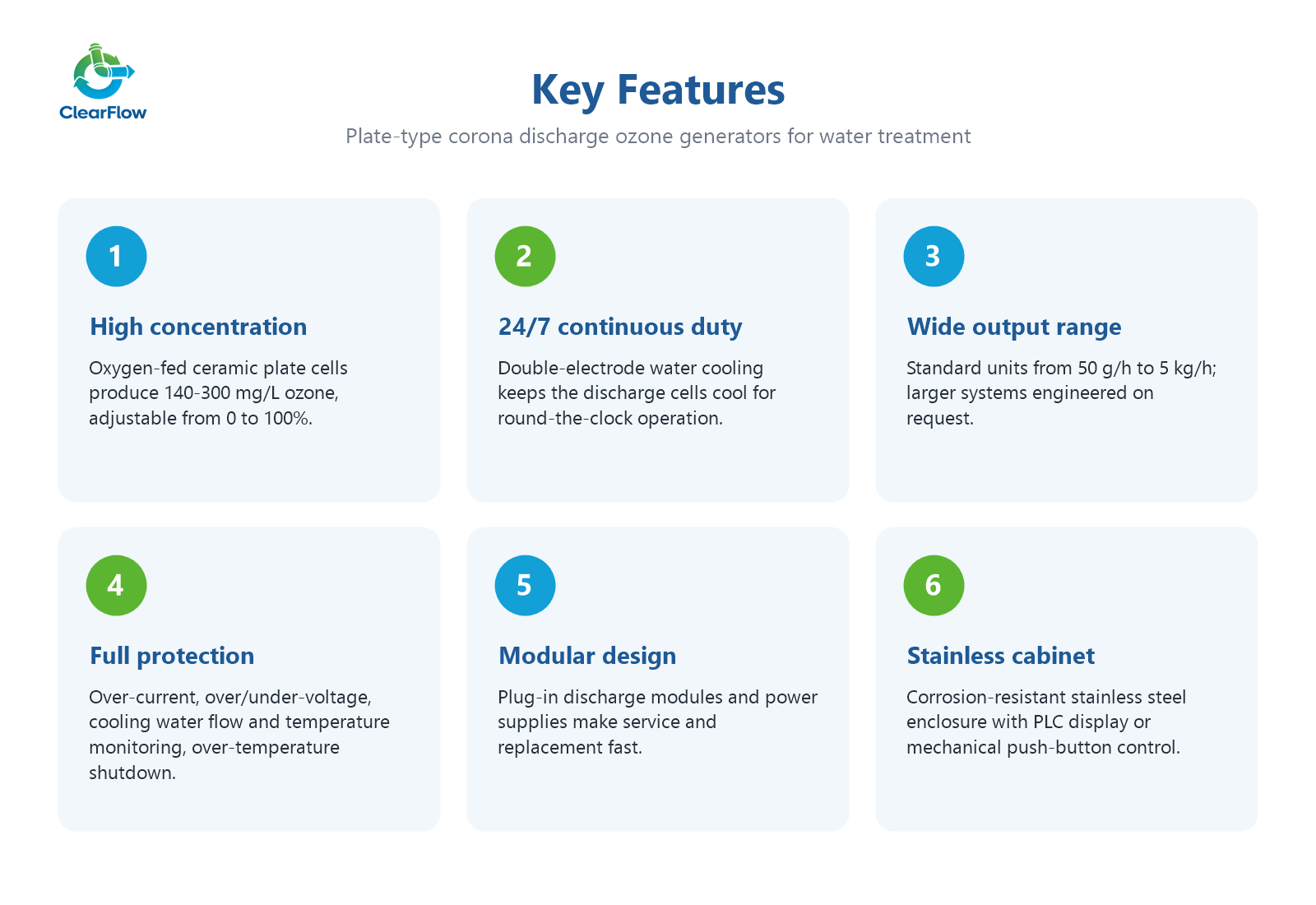
3. Key Features and Advantageslls3.1 High-Concentration Ozone Output
The system produces ozone at concentrations of 140–300 mg/L using oxygen-fed corona discharge technology.
High-concentration ozone helps reduce the amount of carrier gas introduced into certain treatment systems and provides flexibility for industrial oxidation and disinfection processes.
Ozone output can be adjusted from 0–100% according to operating requirements.
3.2 Water-Cooled Design for Continuous Operation
Unlike air-cooled systems, the water-cooled ozone generator uses a double-electrode water-cooling structure to help remove heat generated during the discharge process.
Key advantages include:
Effective heat dissipation during continuous operation.
Improved temperature control of discharge components.
Support for 24-hour, 7-day continuous operation.
Suitable for medium- and large-scale industrial ozone applications.
3.3 Wide Ozone Production Capacity
ClearFlow offers multiple ozone generator models to accommodate different treatment requirements.
Small-capacity models: 50–500 g/h.
Medium-capacity models: 1–2 kg/h.
Large-capacity models: 5 kg/h.
Customized high-capacity systems are available upon request.
Customers can select a suitable model according to the required ozone dosage, water flow, treatment objectives, and operating conditions.
3.4 Comprehensive Safety Protection
The ozone generator integrates multiple monitoring and protection functions to help ensure safe and stable operation.
Protection functions include:
Over-current protection.
Over-voltage and under-voltage protection.
Cooling water flow monitoring.
Cooling water temperature monitoring.
Over-temperature alarm and automatic shutdown.
These functions help protect electrical and discharge components against abnormal operating conditions.
3.5 Modular Structure for Easy Maintenance
The modular design incorporates plug-in discharge modules and power supply units.
This design offers several benefits:
Convenient module replacement.
Easier inspection and maintenance.
Reduced complexity during component servicing.
Flexible maintenance for different equipment capacities.
3.6 Stainless Steel Cabinet and Flexible Control
The ozone generation system is housed in a stainless steel cabinet designed for industrial environments.
Available control options include:
PLC automatic control with display.
Manual mechanical push-button control.
Adjustable ozone output.
Integrated operating status monitoring and protection functions.
The control configuration can be selected according to project requirements.
4. Product Details and Main Components
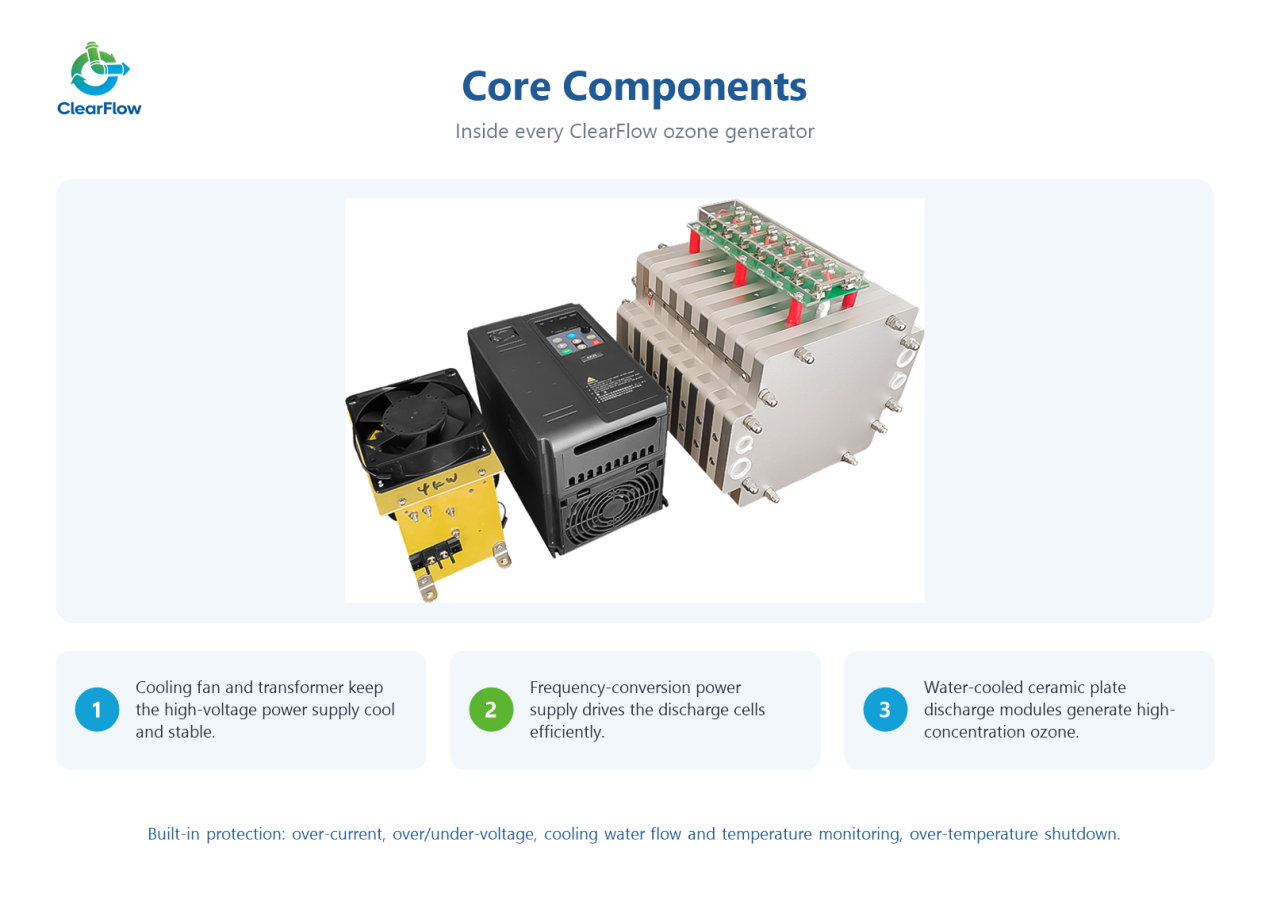
A complete water-cooled ozone generator consists of several key components that work together to ensure stable ozone production.
Ceramic Plate Corona Discharge Ce
The discharge cells are the core ozone-generating components. They use a high-voltage electric field to convert oxygen molecules into ozone.
The ceramic plate structure is designed for high-concentration ozone production.
High-Voltage Power Supply
The power supply provides the electrical energy required for corona discharge. It works with the discharge modules to control the ozone generation process.
Double-Electrode Water-Cooling System
The water-cooling system helps remove heat generated during ozone production and maintains suitable operating temperatures.
Oxygen Feed System
The generator uses an external oxygen source with an oxygen purity of at least 90%. Stable oxygen supply pressure and flow are important for consistent ozone production.
Control and Protection System
The control system monitors equipment operation and provides protection against electrical and cooling system abnormalities.
Stainless Steel Enclosure
The cabinet houses the main electrical and ozone generation components, providing an organized installation structure for industrial applications.
5. Technical Specifications of Water-Cooled Ozone Generators
ClearFlow provides a range of water-cooled ozone generators with ozone output capacities from 50 g/h to 5 kg/h.
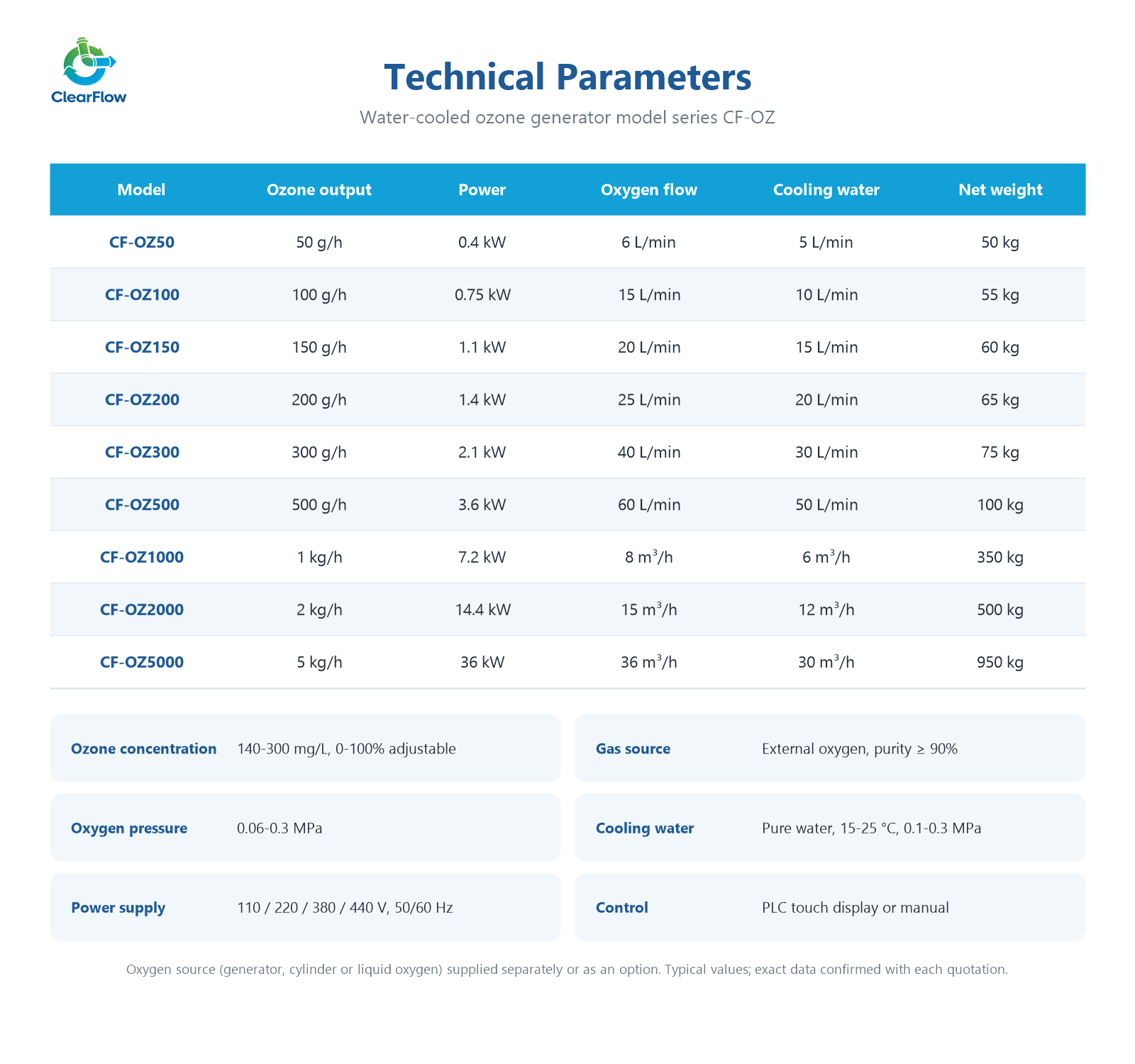
Note: Actual equipment configuration and electrical specifications may vary according to the selected model and project requirements. Please confirm the applicable power supply and operating conditions before ordering.
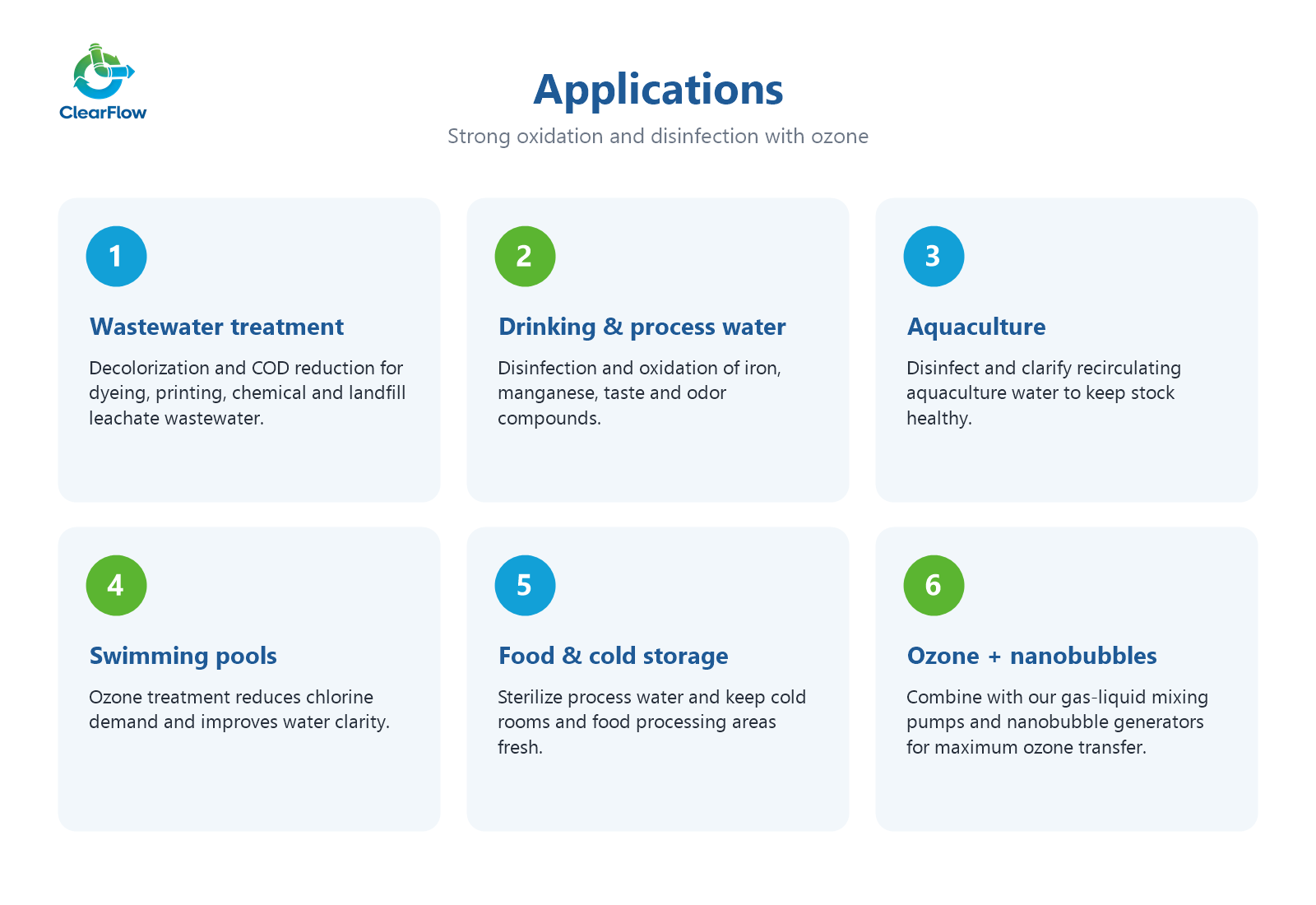
6. Applications of Water-Cooled Ozone Generators
Water-cooled ozone generators are widely used in industrial and commercial water treatment systems where ozone oxidation and disinfection are required.
6.1 Industrial Wastewater Treatment
Ozone is a strong oxidizing agent that can be used in industrial wastewater treatment to oxidize certain organic compounds, assist in color removal, and improve effluent quality.
Typical applications include:
Textile and dyeing wastewater decolorization.
Chemical industry wastewater treatment.
Printing and dyeing wastewater oxidation.
Advanced wastewater treatment.
Reduction of certain COD components.
Actual COD reduction and decolorization performance depend on wastewater composition, ozone dosage, contact time, and the overall treatment process.
6.2 Drinking Water and Process Water Disinfection
Ozone is used as an oxidant and disinfectant in water treatment systems.
Typical applications include:
Drinking water treatment.
Industrial process water disinfection.
Water purification systems.
Oxidation of certain organic and inorganic contaminants.
Pretreatment and advanced water treatment processes.
6.3 Aquaculture Water Treatment
In aquaculture systems, ozone can be used to help control microorganisms and improve water quality.
Applications include:
Fish farming water treatment.
Recirculating aquaculture systems (RAS).
Aquaculture water disinfection.
Water clarification and oxidation.
Treatment of recirculated water.
Ozone residuals must be properly controlled before treated water is returned to aquatic organisms.
6.4 Swimming Pool Water Treatment
Ozone can be used as part of a swimming pool water treatment system to support disinfection and oxidation.
Typical applications include:
Commercial swimming pools.
Hotel swimming pools.
Indoor swimming facilities.
Spa and recreational water systems.
Ozone treatment is generally integrated with an appropriate residual disinfectant and filtration system.
6.5 Food Processing and Cold Storage
Ozone can be applied in selected food processing and cold storage environments for microbial control and sanitation.
Potential applications include:
Food processing water treatment.
Cold storage sanitation.
Food washing water disinfection.
Process equipment and facility sanitation.
The ozone concentration, exposure time, and application method must comply with applicable food safety regulations.
6.6 Ozone Nanobubble Water Treatment Systems
For applications requiring improved ozone dissolution, the ozone generator can be integrated with gas-liquid mixing pumps and ozone nanobubble generators.
This combination can improve gas-liquid contact and ozone transfer efficiency, depending on the system design and operating conditions.
7. Integrated Ozone Generation and Mixing Solutions
ClearFlow does not only provide ozone generators. We can also integrate ozone generation equipment with downstream ozone mixing and transfer equipment to create a complete ozone treatment solution.
Water-Cooled Ozone Generator + Gas-Liquid Mixing Pump
The ozone generator produces high-concentration ozone gas, while the gas-liquid mixing pump helps mix ozone with water and improve gas-liquid contact.
Suitable for industrial water treatment, wastewater oxidation, and disinfection systems.
Water-Cooled Ozone Generator + Nanobubble Generator
The nanobubble generation system is designed to disperse gas into water as fine bubbles, improving gas-liquid interfacial contact and supporting ozone transfer.
Suitable for advanced oxidation, aquaculture water treatment, and other ozone-based water treatment applications.
Customized Ozone Treatment Systems
Depending on project requirements, ClearFlow can help configure an ozone treatment system based on:
Required ozone production capacity.
Water flow rate.
Raw water or wastewater characteristics.
Required treatment objectives.
Oxygen supply conditions.
Ozone mixing and contact methods.
Contact our engineering team to discuss your project requirements and equipment configuration.
8. How to Choose the Right Industrial Ozone Generator
Selecting the correct ozone generator is essential for achieving the required treatment performance and operating efficiency.
Before selecting a model, consider the following factors:
1. Required Ozone Output
Determine the required ozone dosage and total ozone demand based on the water flow rate and treatment objectives.
2. Water Quality
Different wastewater and water sources have different ozone demands. Organic matter, suspended solids, pH, and other water quality characteristics can affect ozone consumption.
3. Oxygen Supply Capacity
Check whether the available oxygen source can provide sufficient oxygen flow, purity, and pressure for the selected model.
4. Cooling Water Conditions
Ensure that the cooling water supply meets the required temperature, pressure, and flow rate.
5. Ozone Mixing Efficiency
The ozone transfer system is an important part of the overall treatment process. Select suitable mixing pumps, injectors, or nanobubble generators according to the application.
6. Automatic Control Requirements
Consider whether the project requires PLC automatic control, manual operation, remote monitoring, or integration with an existing water treatment control system.
For accurate model selection, provide ClearFlow with your water flow rate, water quality information, treatment objectives, and available operating conditions.
9. Frequently Asked Questions
Q1: What is a water-cooled ozone generator?
A water-cooled ozone generator is an industrial device that produces ozone from oxygen through corona discharge technology. It uses circulating cooling water to remove heat generated during operation, helping maintain stable equipment temperatures.
Q2: What is the difference between air-cooled and water-cooled ozone generators?
The main difference is the cooling method.
Air-cooled ozone generators use air circulation or fans to dissipate heat, while water-cooled ozone generators use circulating water for heat removal.
Water-cooled systems are commonly selected for higher-capacity applications and projects requiring continuous industrial operation. The appropriate type depends on ozone output, installation conditions, and operating requirements.
Q3: What ozone concentration can ClearFlow water-cooled ozone generators produce?
ClearFlow water-cooled ozone generators are designed to produce ozone concentrations of 140–300 mg/L using an external oxygen source.
The actual concentration depends on the equipment model and operating conditions.
Q4: What is the ozone production capacity?
Standard models range from 50 g/h to 5 kg/h.
Larger-capacity ozone generation systems can also be customized according to project requirements.
Q5: Can the ozone generator operate continuously?
Yes. The water-cooled design supports 24/7 continuous-duty operation when the oxygen supply, cooling water, power supply, and other operating conditions meet the equipment requirements.
Regular inspection and maintenance are recommended.
Q6: Does the ozone generator require an oxygen source?
Yes. This series uses an external oxygen source with a purity of at least 90%.
The oxygen supply pressure should be maintained between 0.06 and 0.3 MPa, with sufficient flow according to the selected model.
Q7: What type of cooling water is required?
The specified cooling medium is pure water.
The recommended operating conditions are:
Water temperature: 15–25°C.
Water pressure: 0.1–0.3 MPa.
Water flow: According to the selected model.
Q8: Can ozone generators be used for wastewater treatment?
Yes. Ozone generators are widely used in wastewater treatment for oxidation, decolorization, and disinfection.
They can also help reduce certain COD components. However, actual treatment performance depends on wastewater characteristics, ozone dosage, and reaction conditions.
Q9: Can the ozone generator be integrated with a nanobubble generator?
Yes. ClearFlow water-cooled ozone generators can be integrated with gas-liquid mixing pumps and ozone nanobubble generators.
These systems help improve ozone dispersion and gas-liquid mass transfer in water.
Q10: Does ClearFlow provide customized ozone generation systems?
Yes. ClearFlow can provide equipment configurations based on the required ozone output, application, water flow rate, oxygen supply, cooling conditions, and control requirements.
Please contact our team with your project details for equipment selection and technical consultation.
10. Why Choose ClearFlow Water-Cooled Ozone Generators?
ClearFlow focuses on industrial water treatment equipment and ozone application solutions.
Our water-cooled ozone generators offer:
Ozone output capacities from 50 g/h to 5 kg/h.
High-concentration ozone generation using oxygen-fed corona discharge technology.
Water-cooled design for continuous industrial operation.
Modular discharge cells and power supply units.
Multiple electrical and safety protection functions.
PLC automatic control or manual operation.
Integration with gas-liquid mixing pumps and nanobubble generators.
Customized equipment configurations for different water treatment projects.
Whether you need an ozone generator for industrial wastewater treatment, aquaculture, process water disinfection, or an integrated ozone nanobubble system, ClearFlow can help you select a suitable solution.
Contact ClearFlow for an Industrial Ozone Generation Solution
Looking for a reliable water-cooled ozone generator for your water treatment project?
Contact ClearFlow and tell us your required ozone output, water flow rate, application, and treatment objectives.
Our team can help you select the appropriate ozone generator model and configure a suitable ozone generation and mixing system.