

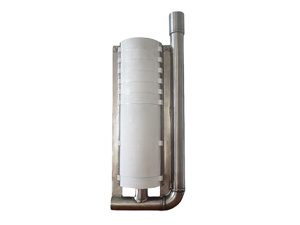
In fact, fine bubble diffuser are easy to install and operate. These aerators produce small and uniform bubbles, feature strong aeration capacity, high oxygen utilization efficiency, high theoretical power efficiency, and low resistance loss, thus enabling energy conservation.There are various manufacturers of fine bubble diffuser on the market. When purchasing fine bubble diffuser, attention must be paid to the following factors, and knowledge such as their working principles should also be understood:
I. Factors to Consider in Selection
To ensure high oxygen utilization efficiency, the bubble diameter diffused by the aerator should be sufficiently small; to achieve thorough mixing of wastewater and keep activated sludge in suspension, the bubble diameter should be adequately large.
To reduce energy consumption of the aerator, its air resistance loss should theoretically be zero.
When the blower restarts, water hammer should be avoided or minimized, and the blower should possess strong resistance to water hammer.
The aerator should have excellent anti-adhesion properties; its interior should not be clogged by dust particles introduced in the air, and its surface should be resistant to microbial adhesion.
The materials used must have good chemical stability, high mechanical strength, and long service life.
Easy installation and replacement.
Adaptable to fluctuations in water volume and quality, facilitating automatic air volume adjustment.
The difference between fine bubble diffuser and conventional aerators lies in their different micropore manufacturing methods. Conventional aerators made of coarse porcelain or corundum produce numerous tiny bubbles during the sintering process. fine bubble diffuser are made of synthetic rubber membranes covering an ABS base, with uniformly distributed pores created by laser or similar methods. Although conventional aerators have the advantages of fine bubbles, large gas-liquid contact area and high oxygen utilization efficiency, they are prone to damage. Once damaged, their oxygen utilization efficiency drops rapidly.
However, the check valve and diaphragm opening design of fine bubble diffuser prevent backflow of wastewater and clogging of micropores, requiring little cleaning and maintenance.
II. Working Process of fine bubble diffuser
During aeration, air enters between the diaphragm and the support body through air vents on the wall. Under the pressure of compressed air, the diaphragm expands slightly, opening the pores to distribute and diffuse air.
When air supply stops and pressure dissipates, the diaphragm automatically closes the pores due to its elasticity. Under water pressure, the diaphragm is pressed tightly against the tube wall, preventing wastewater from backflowing and clogging the pores.
Nevertheless, since the opening diameter of the membrane directly affects oxygen utilization efficiency, it must be appropriate. An excessively large opening diameter results in low oxygen utilization efficiency, while an overly small one improves efficiency but increases resistance. The rubber diaphragm should be made of high-strength rubber compound to prevent rupture and aerator failure.