

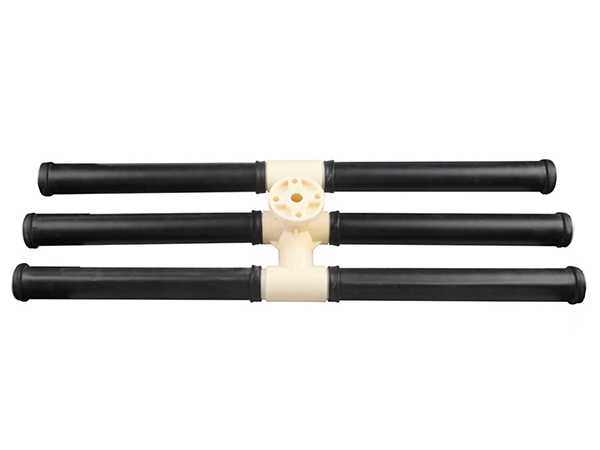
The core working principle of a wastewater aeration system is to increase the concentration of dissolved oxygen (DO) in the water by injecting air (or pure oxygen) into the wastewater, providing oxygen required for the survival and metabolism of aerobic microorganisms, thereby promoting the biodegradation of organic pollutants in the wastewater. This process is a key part of mainstream wastewater treatment technologies such as the activated sludge process and biofilm process.
The aeration system achieves oxygen transfer and mixing mainly through the following three methods:
1. Diffused Air Aeration
This is the most common method used in large-scale wastewater treatment plants. The system consists of blowers, air pipelines, and aerators (such as microporous aeration discs or diffusers).
Working Process:The blower pressurizes air and delivers it through pipelines to the aerators installed at the bottom of the tank.
Oxygen Transfer Mechanism:Aerators (especially microporous types) disperse air into a large number of tiny bubbles (usually 0.1–0.5 mm in diameter), greatly increasing the gas-liquid contact area and significantly improving the oxygen transfer efficiency (up to 25%–35%).
Advantages:High oxygen utilization rate, relatively low energy consumption, stable operation; suitable for large plug-flow aeration tanks.
2. Mechanical Aeration (Surface Aeration)
Air and water are fully mixed by violently agitating the water body through mechanical devices installed on the water surface, such as impellers, brush aerators, or disc aerators.
Working Process:When the impeller rotates, it throws water into the air to form water curtains or droplets, expanding the contact interface between air and water, so that oxygen dissolves into the water.
Advantages:Simple structure, convenient installation and maintenance; commonly used in oxidation ditches and small wastewater treatment facilities.
Limitations:Lower oxygen utilization rate than microporous aeration, and certain restrictions on water depth.
3. Jet Aeration
Aeration is realized using the principle of “negative pressure suction” in fluid dynamics.
Working Process:High-pressure water is ejected at high speed through a nozzle, creating a negative pressure zone around the nozzle, which sucks in air and mixes it thoroughly with the water flow in the mixing tube. The fine gas-liquid mixture is then jetted back into the wastewater.
Advantages:No blower required, compact equipment; suitable for space-limited sites or high-concentration wastewater treatment, with good mixing capability.
Applications:Commonly used in submersible aeration equipment, such as submersible jet aerators.